
Local News
Lagos Condemns Korope Blockade, Reaffirms Lekki Bus Reform Drive
Mini bus operators, popularly known as Korope


The Lagos State Government has condemned the recent blockage of the CMS–Lekki–Epe Expressway by mini bus operators, popularly known as Korope, describing the disruption as a breach of agreements reached with transport unions and stakeholders.
The disruption occurred on Tuesday, February 17, and Wednesday, February 18, 2026, and was contrary to resolutions jointly adopted by the government, the National Union of Road Transport Workers (NURTW), and the Road Transport Employers Association of Nigeria (RTEAN) after extensive consultations on the Bus Reform Initiative for the Lekki–Epe corridor.
Discussions on the reform began in 2024, culminating in a stakeholders’ meeting on June 27, 2024, where a communique was endorsed by the Special Adviser on Transportation, Hon. Sola Giwa, the Permanent Secretary of the Ministry of Transportation, and union leaders.
The resolutions included restructuring public transport operations, deploying high-capacity buses in line with the Lagos State Transport Policy and Bus Route Network, reassigning Korope minibuses to inner arterial routes, introducing electronic ticketing, and standardizing operations to improve safety and security.
At a subsequent meeting on December 2, 2025, stakeholders unanimously agreed that the new bus scheme would commence on December 8, 2025. The first phase of the reform is expected to cover Ajah to CMS Marina/Obalende, Ajah to Oshodi, Ajah to Berger, and Ajah to Iyana Ipaja, with plans to extend the scheme to Epe.
The meeting, chaired by Hon. Sola Giwa, clarified that one operator would provide express services, while other operators would run stopping services along the corridor.
Giwa reiterated the government’s commitment to formalizing transit operations across Lagos with a focus on commuter comfort, safety, security, and fare stability.
Under the new scheme, participating buses will feature the Lagos State blue-and-white regulated colour scheme, active QR codes embedded in Public Transport Compliance Stickers (PTCS), unique identification codes, and Touch and Pay ticketing stickers. Drivers are also required to display official Ministry of Transportation badges to enhance accountability and public confidence.

The government urged all transport operators to comply with the reform framework, reaffirming its commitment to building a safe, orderly, and efficient transportation system for Lagos residents.

The Nigeria Civil Aviation Authority (NCAA) has introduced a comprehensive eight-pillar regulatory framework aimed at strengthening economic oversight of Nigeria’s aviation industry, promoting fair competition and protecting consumers without discouraging investment.
Director-General of the NCAA unveiled the framework while presenting a paper titled “Taming Natural Monopoly” at the Airport Business Summit and Expo (ABSE) 2026 held at the NIGAV Centre in Lagos.
He said the initiative reflects the Authority’s commitment to ensuring that natural monopolies, which are common in aviation due to the enormous capital required to develop critical infrastructure, operate in the public interest.
According to the NCAA boss, monopoly itself is not the challenge, but the abuse of market power.
“Natural monopolies are necessary in aviation but require effective regulation to prevent abuse of market power,” he said, describing a natural monopoly as a market where a single provider can efficiently deliver services at lower cost than multiple competing firms.
He explained that Nigeria’s aviation sector continues to grapple with high operating costs, infrastructure limitations, multiple charges, limited competition and consumer complaints, making stronger economic regulation necessary to sustain industry growth.
The Director-General noted that the Civil Aviation Act (CAA), 2022 and the Nigeria Civil Aviation Regulations (Nig.CARs), 2023 provide the legal authority for the NCAA to regulate airline licensing, market access, tariffs, consumer protection, competition and access to aviation infrastructure.
He said the regulatory framework aligns with International Civil Aviation Organization (ICAO) standards while balancing commercial viability with public interest.
“Our regulatory approach must balance commercial viability with public interest, ensuring that monopoly operators do not abuse their position,” he stated.
The eight regulatory pillars cover Economic Licensing, Consumer Protection, Tariff and Charges Approval, Economic Oversight, Competition and Market Access, Aerodrome Certification, Air Navigation Service Provider Licensing, and Enforcement and Penalties.
According to him, the framework is designed to guarantee transparent licensing processes, fair competition, cost-related and non-discriminatory tariffs, quality service delivery, operational reliability and effective enforcement of regulatory provisions.
He stressed that under the new approach, monopoly operators would not be allowed to unilaterally determine charges, while passenger rights, refunds, accessibility and service quality would receive greater regulatory attention.
Looking ahead, the NCAA plans to establish a dedicated Economic Regulation Unit, strengthen oversight of airport concessions and public-private partnerships, implement price-cap and revenue-cap models, enforce non-discriminatory market access, introduce service-level agreements and publish industry performance dashboards.
The Director-General expressed confidence that the reforms would create a predictable investment climate, improve transparency, strengthen airline competitiveness and enhance passenger confidence.
He maintained that Nigeria already possesses the legal instruments needed to regulate monopoly behaviour effectively and pledged that the Authority would apply the regulations proactively to ensure fairness, efficiency and accountability across the aviation sector.
“A competitive aviation industry is not achieved by eliminating monopoly, but by regulating monopoly in the public interest,” he said.
Airlines
NAHCO Collision Disrupts Air Peace Operations
An Air Peace Airbus A320 damaged after a NAHCO baggage conveyor belt vehicle struck its engine at Murtala Muhammed Airport, Lagos.
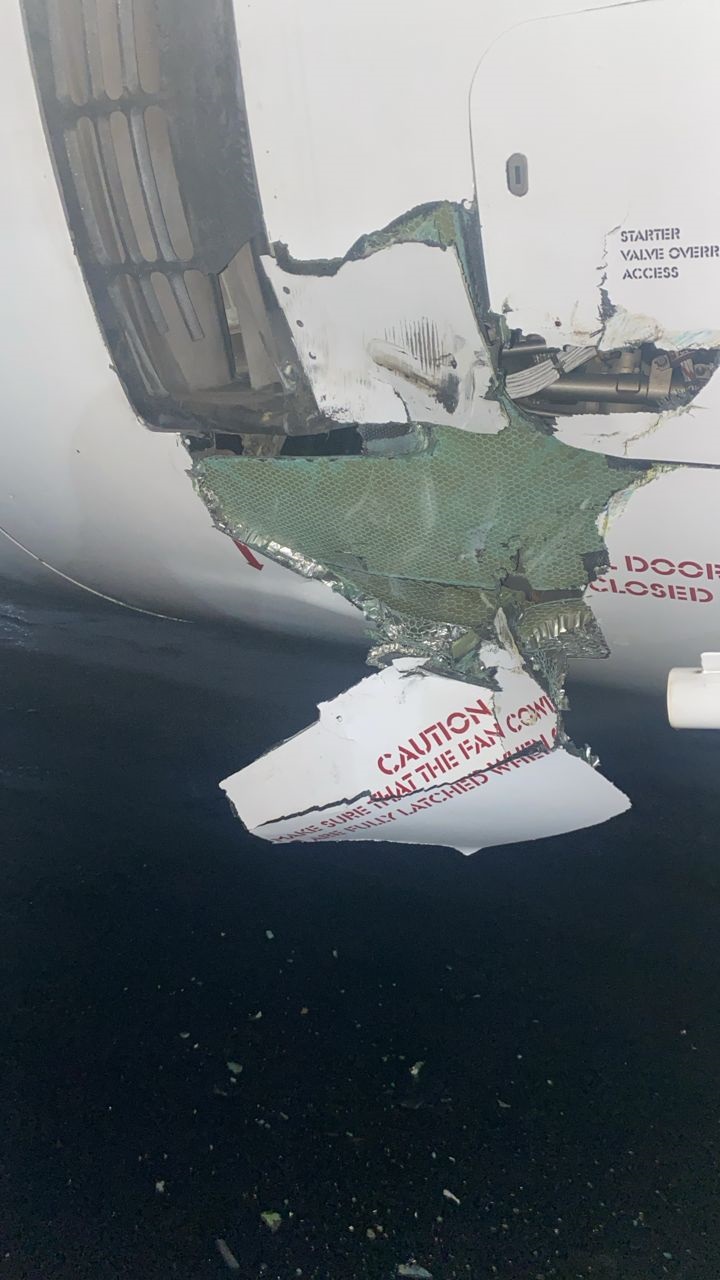
Flight operations on the Air Peace network have been disrupted after a ground handling vehicle belonging to the Nigerian Aviation Handling Company (NAHCO) collided with one of the airline’s Airbus A320 aircraft at the Murtala Muhammed Airport Terminal 1 (MMA1), Lagos.
Air Peace confirmed that the incident occurred shortly after Flight P47427 arrived from Kano and passengers had safely disembarked from the aircraft.
According to the airline, a NAHCO baggage conveyor belt vehicle struck the aircraft’s engine, causing extensive damage and rendering the Airbus A320 unserviceable.
In a statement issued by its management, Air Peace said the damaged aircraft had been scheduled to operate several flights across its domestic network in the coming days, adding that the incident would inevitably affect flight operations.
The airline warned that the unexpected development would lead to delays on several scheduled services, while some flights could be cancelled as it works to adjust its fleet and minimise operational disruptions.
Air Peace apologised to passengers whose travel plans may be affected, assuring them that its operations and customer service teams have been mobilised to provide alternative travel arrangements and necessary assistance where possible.
The airline said it is working closely with the ground handling company and relevant aviation authorities to determine the circumstances surrounding the incident and ensure measures are put in place to prevent a recurrence.

It reiterated that the safety of its passengers, crew and equipment remains its highest priority and thanked customers for their patience, understanding and continued support as it manages the operational challenges arising from the incident.
Airlines
Ooni, Sultan to Lead Dignitaries at Bankole Biography Launch
Alhaji Muneer Bankole, Chairman of Medview Airlines

The Ooni of Ife, His Imperial Majesty Oba Adeyeye Enitan Ogunwusi, CFR, and the Sultan of Sokoto, His Eminence Alhaji Muhammad Sa’ad Abubakar III, are among an array of eminent personalities expected to grace the launch of Pathways, Pilgrimage and Destiny, the biography of Medview Airlines owner and renowned businessman, Alhaji Muneer Bankole.
Also expected at the event are the Oba of Lagos, His Royal Majesty Oba Rilwan Babatunde Osuolale Aremu Akiolu I, alongside other first-class traditional rulers, senior government officials, captains of industry, diplomats, religious leaders and members of the business community.
The organisers said the event will celebrate the life and accomplishments of Bankole, whose entrepreneurial journey has left a significant imprint on Nigeria’s aviation industry, Hajj and Umrah travel sector and philanthropic landscape.
The biography chronicles Bankole’s rise from humble beginnings to becoming one of Nigeria’s notable entrepreneurs, highlighting his contributions to aviation, his role in expanding pilgrimage travel services and his enduring commitment to leadership, humanitarian causes and community development.
According to the organisers, the book presents an inspiring account of resilience, enterprise, faith and determination while documenting the defining moments that shaped Bankole’s personal and professional life.
They added that Pathways, Pilgrimage and Destiny also examines his efforts in creating employment opportunities, supporting humanitarian initiatives and contributing to Nigeria’s economic development.
Describing the publication as more than a biography, the organisers said it is a tribute to a life defined by vision, perseverance and unwavering service to humanity.
They noted that the book is expected to inspire entrepreneurs, students, young professionals and leaders by showcasing the values of hard work, integrity, faith and dedication.
The launch will feature a public presentation of the book, a formal review by a distinguished scholar, goodwill messages from eminent personalities, cultural performances and tributes celebrating Bankole’s contributions to national development.

The gathering is expected to attract leading figures from the traditional institution, government, business, academia and the diplomatic community, making it one of the major literary and social events of the year.

NCAA Maps Out Eight-Pillar Aviation Strategy

FAAN Rolls Out Biometric V-Pass for Faster, Safer Domestic Air Travel

FLIDAN Pushes Stronger Flight Dispatch Standards to Boost Aviation Safety

Air Peace Expands Domestic Flight Schedule

Gateway International Airport Takes Off as Ogun Joins Nigeria’s Air Map

Nigeria, UAE Firm Sign Landmark Cargo Information Deal
-
 Airlines1 month ago
Air Peace Expands Domestic Flight Schedule
-
 Aviation10 months ago
Gateway International Airport Takes Off as Ogun Joins Nigeria’s Air Map
-
 Aviation10 months ago
Nigeria, UAE Firm Sign Landmark Cargo Information Deal
-

 Airlines10 months ago
₦100m Land Deal: Air Peace Backs Onyema’s Claim on Anambra Airport
-
 Airlines10 months ago
UK Partnership Opens Heathrow, Gatwick Gates for Air Peace – Onyema
-

 Airlines10 months ago
High Airfares, Hot Hotels: Nigeria’s Travel Paradox
-

 AIRPORTS11 months ago
MMA2 Named Nigeria’s Best Cargo Airport, Jibodu Honored
-

 Airlines10 months ago
Aborted Take-off: Air Peace Assures Passengers of Safety on Abuja–Asaba Flight