
Business
Auto Giants Confirm for Nigeria EV, CNG Summit
NAJA Summit 2026


Leading automobile manufacturers, transport regulators and key government agencies have confirmed participation in the 2026 Nigeria Auto Industry Summit (NAISU), reinforcing industry support for Nigeria’s transition to electric vehicles (EVs) and Compressed Natural Gas (CNG)-powered transportation.
The summit, organised by the Nigeria Auto Journalists Association (NAJA) in collaboration with the National Automotive Design and Development Council (NADDC), will hold on Thursday, July 30, 2026, at the Radisson Hotel, Ikeja, Lagos.
Major automotive companies that have confirmed participation include Weststar Associates Limited, Toyota (Nigeria) Limited, Jetour Nigeria, Carloha Nigeria, Simba Group, Cedric Masters Group, Coscharis Motors and Lanre Shittu Motors.
The event is also expected to attract policymakers, investors, financial institutions, fleet operators, technology providers and other stakeholders in Nigeria’s automotive industry.
The Corps Marshal of the Federal Road Safety Corps (FRSC), Shehu Mohammed, will deliver the keynote address on road safety, regulation and the deployment of electric and CNG-powered vehicles in Nigeria.
Also confirmed as guest speakers are the Director-General of the National Automotive Design and Development Council (NADDC), Joseph Osanipin, and the Chairman/Chief Executive Officer of the Presidential Initiative on Compressed Natural Gas and Electric Vehicles (Pi-CNG and EV), Ismaeel Ahmed.
The speakers are expected to provide insights into the Federal Government’s automotive industrialisation agenda, clean mobility policies and ongoing initiatives aimed at accelerating the adoption of alternative fuel vehicles across the country.
The 2026 summit is themed “Nigeria’s Clean Mobility Future: The EV and CNG Journey Under the Bola Tinubu Administration.”
Chairman of the 2026 Auto Summit Planning Committee, Rasheed Bisiriyu, said the event comes at a critical period as Nigeria intensifies efforts to reduce transportation costs, lower carbon emissions and encourage greater investment in cleaner mobility solutions.
According to him, the summit will bring together government officials, automotive manufacturers, regulators, energy experts and transport stakeholders to review ongoing reforms and develop practical strategies for advancing the country’s clean mobility agenda.
Bisiriyu said discussions would focus on expanding EV charging infrastructure and CNG refuelling stations, promoting local vehicle assembly, improving consumer awareness, attracting private sector investment and strengthening the regulatory framework needed to support sustainable transportation.
He added that the summit is designed to move beyond policy discussions by generating practical recommendations capable of accelerating Nigeria’s transition to cleaner mobility.
NAJA Chairman, Theodore Opara, said the annual summit has become one of Nigeria’s foremost automotive policy dialogue platforms, bringing together public and private sector stakeholders to address critical issues affecting the industry’s growth.
He stressed that achieving Nigeria’s clean mobility objectives requires collaboration among regulators, manufacturers, energy providers, transport operators, safety agencies and consumers.
Organisers expressed confidence that the summit would generate actionable recommendations to support the Federal Government’s drive to deepen investment in alternative fuel technologies, strengthen local automotive manufacturing, improve transport sustainability and position Nigeria as a leading player in Africa’s emerging clean mobility ecosystem.
AIRPORTS
Babalakin Hails Tinubu Over MMA2 Dispute Settlement
Chairman of Bi-Courtney Aviation Services Limited (BASL), Dr. Wale Babalakin, (SAN) in handshake with the Aviation Minister – Mr. Festus Keyamo (SAN) in Abuja

…Pledges quality jobs for Nigerians
The Chairman of Bi-Courtney Aviation Services Limited (BASL), Dr. Wale Babalakin, SAN, has commended President Bola Tinubu for facilitating the settlement of the more than 18-year dispute surrounding the Murtala Muhammed Airport Terminal Two (MMA2), describing the agreement as a victory for Nigeria.
Babalakin gave the commendation at the signing ceremony involving the Federal Government, the Federal Airports Authority of Nigeria (FAAN), Bi-Courtney Limited and Stabilini Visinoni Limited, following the resolution of the longstanding disagreement.
He credited the President’s intervention, facilitated through the Minister of Aviation and Aerospace Development, Festus Keyamo, SAN, with helping to resolve the impasse.
“This is not a win for us alone; it is a win for Nigerians,” Babalakin said, while expressing appreciation to the President, the minister and Nigerians who had followed the dispute over the years.
The development is expected to provide a basis for renewed cooperation among the parties and create opportunities for further infrastructure development and expanded operations at MMA2.
In a statement signed by the Head of Corporate Communications, Bi-Courtney Aviation Services Limited, Mrs. Ajoke Yinka-Olawuyi, the company said the settlement also addresses outstanding issues arising from the parties’ longstanding commercial relationship, including matters relating to the General Aviation Terminal (GAT), which remained under FAAN’s control and operation.
The agreement incorporates reciprocal concessions and revised obligations, providing a framework for the parties to move forward.
Babalakin said the resolution sends a positive signal to investors that longstanding disputes between government and private businesses can be resolved through dialogue and constructive engagement.
He noted that prolonged uncertainty could discourage long-term investment, adding that the settlement presents an opportunity to strengthen confidence in Nigeria’s investment environment.
The agreement is also expected to facilitate progress on key projects at MMA2, including the proposed Hotel and Conference Centre and the commencement of regional flight operations.
According to Babalakin, completing the hotel and conference facility would provide accommodation and meeting facilities for business travellers, corporate organisations and other airport users, while creating employment opportunities in construction, engineering, hospitality and facility management.
The planned regional flight operations, alongside the proposed expansion of the airport apron, are also expected to create opportunities for skilled employment and commercial growth.
Babalakin assured stakeholders that Bi-Courtney would fulfil its obligations under the agreement and work with the relevant parties to implement its provisions.
“We will not disappoint the President, the Ministry of Aviation and Aerospace Development, FAAN or Nigerians,” he said.

He added that the settlement offered an opportunity to strengthen cooperation, advance infrastructure development and realise MMA2’s full potential.
Airlines
United Nigeria Airlines Targets January Cargo Flights at Ekiti
United Nigeria Airlines Fleet

United Nigeria Airlines (UNA) plans to commence commercial cargo operations at Ekiti Airport in January 2027, with daily passenger services also in the pipeline as the state government advances infrastructure upgrades.
The airline’s Chairman, Prof. Obiora Okonkwo, announced the plan on Monday during the commissioning of Reeve Energy Limited’s aviation fuel tank farm at the airport, saying the carrier was ready to support the movement of agricultural produce and other goods from Ekiti to markets across Nigeria and, eventually, overseas.
Okonkwo said the airline would be ready to commence cargo services once the state government was prepared to begin commercial exports from the airport. He pledged that United Nigeria Airlines would be the first carrier to lift commercial cargo from the facility when operations begin.
“By January next year, we will activate a cargo section of our flights so that we can work out a deal. As soon as you are ready to start exporting cargo from here, whether to other parts of Nigeria or beyond, we will be ready,” he said.
He added that the airline intended to introduce daily passenger flights to Ekiti, subject to the completion of ongoing airport infrastructure improvements.
The airline chairman described the commissioning of the fuel tank farm as an important development that would support flight operations and provide a foundation for future expansion at the airport.
Okonkwo said reliable aviation fuel supply was particularly important to the airline, which he described as Nigeria’s second-largest consumer of aviation fuel after Air Peace.
He explained that the Ekiti State Government selected United Nigeria Airlines for the partnership after assessing the operational capacity and fleet strength of domestic airlines, rather than following an application or lobbying process by the carrier.
According to him, the airline had sustained its commitment to the state by maintaining services even during periods of low passenger demand.
Ekiti State Governor, Biodun Oyebanji, said his administration was committed to completing the airport’s ongoing infrastructure projects by the end of 2026 to improve its operational capacity and attract further private-sector investment.
Oyebanji said the planned improvements included an upgrade of the airport’s Instrument Landing System (ILS) and the installation of aerodrome ground lighting to support operations beyond daylight hours.
He put the estimated cost of the ground lighting project at more than ₦10 billion, adding that the completed system would enable aircraft to land at the airport at any time, subject to applicable operational and regulatory requirements.
The governor also disclosed that the state government was pursuing an Independent Power Producer arrangement to ensure a reliable electricity supply for the airport and reduce dependence on external power sources.
He commended Reeve Energy Limited for investing in the state and reaffirmed his administration’s commitment to providing an enabling environment for businesses.

The planned cargo service could open additional routes for Ekiti’s agricultural produce and other goods, while the proposed daily passenger flights would improve the state’s air connectivity. Their implementation will depend on cargo-export readiness, infrastructure completion and the relevant operational requirements.
Aviation
AAAU, NCAT Seek Digital Overhaul of Aviation Training
The Acting Vice-Chancellor of the African Aviation and Aerospace University (AAAU), Dr Mustapha Abdullahi, and the Rector of the Nigerian College of Aviation Technology (NCAT), Dr Ismaila Danjuma, at the second international conference organised by AAAU’s Department of Aviation Business in Abuja.
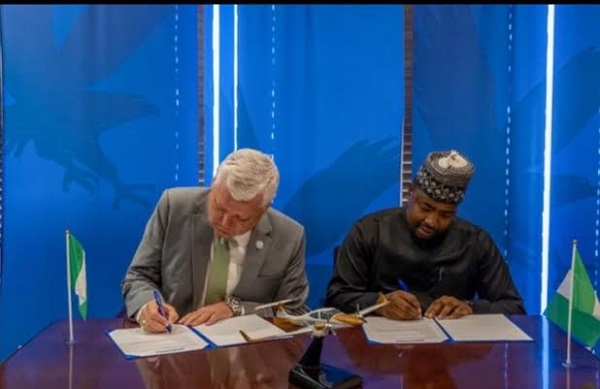
The African Aviation and Aerospace University (AAAU) and the Nigerian College of Aviation Technology (NCAT) have called for a shift towards digital-focused aviation training, warning that traditional methods alone may not adequately prepare professionals for emerging industry challenges.
The institutions said stronger research, innovation and collaboration among training institutions, regulators and industry operators were necessary to equip Africa’s aviation workforce with the skills required to manage technological changes and evolving safety demands.
The call was made on Tuesday at the second international conference organised by AAAU’s Department of Aviation Business in Abuja, where stakeholders examined the future of aviation education amid digital transformation and changing industry requirements.
The Acting Vice-Chancellor of AAAU, Dr Mustapha Abdullahi, said the university was committed to advancing knowledge, influencing policy and promoting research in aviation, aerospace and environmental science.
Abdullahi described the conference as evidence of the institution’s commitment to research and intellectual development, despite being in its formative years. He also acknowledged NCAT’s support, saying collaboration between the institutions could strengthen professional training and aviation capacity development across Africa.
NCAT Rector, Dr Ismaila Danjuma, said aviation training institutions must adapt their programmes to technological innovation, changing regulatory frameworks, emerging safety and security requirements, and evolving passenger expectations.
He noted that Africa’s growing population, rising air traffic and regional integration initiatives, including the African Continental Free Trade Area (AfCFTA) and the Single African Air Transport Market (SAATM), were increasing the demands on the continent’s aviation sector.
According to Danjuma, training institutions must strengthen research, encourage innovation and promote continuous professional development while building closer relationships with universities, regulators and aviation operators.
He stressed that the competence of pilots, aircraft engineers, air traffic controllers, flight dispatchers, safety inspectors, managers and regulators remained critical to aviation safety, operational efficiency and the industry’s long-term sustainability.
Danjuma said NCAT had trained aviation professionals for Nigeria and other African countries for more than 60 years, with its recognition as an International Civil Aviation Organisation Regional Training Centre of Excellence with Platinum status reflecting its contribution to aviation capacity development.
He, however, said the college was focused on preparing professionals not only for existing responsibilities but also for emerging technological and operational challenges.
“We must move from training for current tasks to training for emerging challenges and opportunities,” he said.
The rector also called for research findings and academic discussions to translate into practical improvements in industry operations and policy, stressing that aviation education must evolve alongside the sector it serves.
The Minister of Aviation and Aerospace Development, Festus Keyamo, reaffirmed the Federal Government’s commitment to developing the industry, with digital transformation and sustainability identified as important priorities for Africa’s multimodal transport system.
Keyamo, represented by the ministry’s Deputy Director of Planning, Research and Statistics, Shittu Ayodeji, said preparing the sector for future demands required attention to technological advancement and sustainable development.
The conference highlighted the need for stronger institutional partnerships and updated training approaches to ensure Africa’s aviation workforce can respond effectively to emerging technologies, regulatory changes and increasing operational demands.

ATSSSAN Backs NAMA Push for Higher TSC, Aviation Clearance Revenue

Abba Secures Second Term as IFATCA Regional VP

SAPTCO Suspends Annual Aviation Lecture

Air Peace Expands Domestic Flight Schedule

Lufthansa Group to Bring Eurowings to Nigeria in 2027

Gateway International Airport Takes Off as Ogun Joins Nigeria’s Air Map
-
 Airlines5 months ago
Air Peace Expands Domestic Flight Schedule
-
 Airlines2 months ago
Lufthansa Group to Bring Eurowings to Nigeria in 2027
-
 Aviation1 year ago
Gateway International Airport Takes Off as Ogun Joins Nigeria’s Air Map
-

 Airlines1 year ago
₦100m Land Deal: Air Peace Backs Onyema’s Claim on Anambra Airport
-

 Aviation1 year ago
Nigeria, UAE Firm Sign Landmark Cargo Information Deal
-

 Airlines1 year ago
High Airfares, Hot Hotels: Nigeria’s Travel Paradox
-
 Airlines1 year ago
UK Partnership Opens Heathrow, Gatwick Gates for Air Peace – Onyema
-

 AIRPORTS1 year ago
MMA2 Named Nigeria’s Best Cargo Airport, Jibodu Honored