
Aviation
Transport Experts Fault Poor Policy Implementation, Political Interference
The stakeholders speaking during the JustNet Seminar in Lagos


Transport experts have identified weak political will, politically driven infrastructure decisions and poor policy implementation as major obstacles to Nigeria’s efforts to develop an efficient and integrated transportation system.
They warned that the country’s ambition to build a transport network capable of supporting trade, reducing logistics costs and withstanding global disruptions would remain unrealised without effective coordination among government agencies, transport operators and private-sector investors.
The stakeholders made the observations at the Second JustNet Nigeria Transport Summit 2026, organised by JustAlive Communications Limited, publishers of JustNet News, at Providence Hotel, GRA, Ikeja, Lagos.
The summit, held under the theme, “Navigating Global Disruptions and the Road Ahead: Mobility, Energy and Trade Facilitation for a Resilient Future,” brought together government representatives, transport operators, logistics professionals and other industry stakeholders to examine challenges confronting the sector.
During the discussions, the experts called for stronger rail connectivity, sustainable infrastructure financing, transparent public-private partnerships and greater consultation with industry operators before governments introduce policies affecting transportation businesses.
The Publisher of MMS Plus, Mr. Kingsley Anaroke, criticised the political considerations influencing rail development in Nigeria, arguing that infrastructure decisions had not consistently reflected commercial needs and actual cargo movement patterns.
He cited the transfer of rail development from the Exclusive Legislative List to the Concurrent Legislative List under former President Muhammadu Buhari as an effort to enable states to develop their own rail systems, but noted that many states still depended on the Federal Government to achieve the policy’s objectives.
Anaroke also questioned the distribution of rail projects across the country, arguing that the South-East and South-South had not enjoyed development comparable to Lagos, Ogun, Kaduna and Kano.
He urged the government to determine rail corridors based on cargo volumes, commercial demand and the movement of goods rather than political considerations.
He further advocated stronger rail connections to the South-East and South-South, alongside greater private-sector participation in rail operations to reduce dependence on road transportation.
The Founder and Chief Executive Officer of Expedite Movers Nigeria Limited, Mrs. Olubowale Iseoluwa, also called for more accessible rail freight services, particularly for small businesses and cargo owners.
She recounted an experience in which she sought to transport two containers from a port towards Maiduguri but was informed by Nigerian Railway Corporation officials that the service could not accommodate the consignment unless she had at least 10 or 11 containers.
She said such operational requirements could discourage businesses from using rail services, stressing that transport infrastructure must be designed around the practical needs of its users.
Similarly, the Managing Director of AZ Logistics, Dr. Azeez Mustapha, identified poor implementation and the failure to connect different transport modes as major challenges to the development of an efficient national transport system.

He maintained that railways, seaports, airports and road networks must function as interconnected components of a single transportation system to facilitate the seamless movement of passengers and cargo.
The Special Adviser to the Lagos State Governor on Blue Economy, Mr. Oluwadamilola Emmanuel, represented by Mr. Shittu Oladimeji of the Lagos State Waterways Authority, emphasised the need for proper planning and feasibility studies before embarking on infrastructure projects.
He warned that constructing facilities without understanding cargo origins, destinations and movement patterns could result in investments that fail to meet their intended objectives.
On the broader challenges of transport resilience, the Managing Director and Chief Executive Officer of Pathfinders International Limited, Mrs. Nkechi Onyenso, called for comprehensive business continuity plans to help companies withstand disruptions, including pandemics, geopolitical tensions and economic uncertainty.
She stressed that government policies must reflect the operational realities of businesses, advocating closer consultation between policymakers and industry operators.
Representing the Managing Director of Aero Contractors, Captain Ado Sanusi, Mr. Benedict Olufemi, also warned that some government decisions failed to account for operational challenges confronting transport businesses.
He said consulting affected operators and assessing available facilities before introducing policies would help identify bottlenecks and prevent avoidable disruptions.
Aviation journalist and media veteran, Mr. Wole Shadare, highlighted the effects of geopolitical crises on oil and gas prices, noting that fluctuations in energy costs could affect aviation, shipping and other transportation services.

The General Secretary of the Aviation Safety Round Table Initiative, Mr. Olumide Ohunayo, called for adequate reserves and stronger cooperation between government and private operators to improve the industry’s ability to withstand economic shocks.
He also urged the government to create an operating environment that would support airline profitability and attract investment.
In a related session, Bi-Courtney Aviation Services Limited (BASL), operators of Murtala Muhammed Airport Terminal Two (MMA2), presented its approach to airport safety, infrastructure management and operational innovation.
BASL’s Head of Safety, Mrs. Nafisat Adeniran, said safety considerations were incorporated into the design, construction and operational arrangements of the terminal.
She disclosed that the company conducts two risk assessments annually to evaluate available resources, identify safety gaps and determine additional measures required to maintain acceptable standards.
Adeniran also highlighted the importance of stakeholder participation, noting that the company provides free fire-safety training to stakeholders operating within the terminal.
BASL’s Head of Corporate Communications, Mrs. Ajoke Yinka-Olawuyi, expressed optimism that the recently signed agreements involving the Minister of Aviation and Aerospace Development, Festus Keyamo, aimed at resolving longstanding disputes among the Federal Government, Federal Airports Authority of Nigeria, BASL and Stabilini Visinoni Limited, would open a new chapter for the concession agreement.
She said resolving the disputes could unlock the agreement’s potential, stimulate economic activities and create more employment opportunities.
Earlier, the Convener of the summit, Mrs. Pearl Ngwama, said the participation of government representatives, industry leaders and other stakeholders reflected the importance of coordinated policies and investments in addressing Nigeria’s transportation challenges.

She stressed that transport development was too critical to the country’s economic future to be managed through fragmented policies and isolated infrastructure investments.
AIRPORTS
Kogi Targets Global Trade Through Airport Project
Festus Keyamo and Ahmed Usman Ododo jointly perform the foundation-laying ceremony to mark the commencement of the Kogi International Airport project.
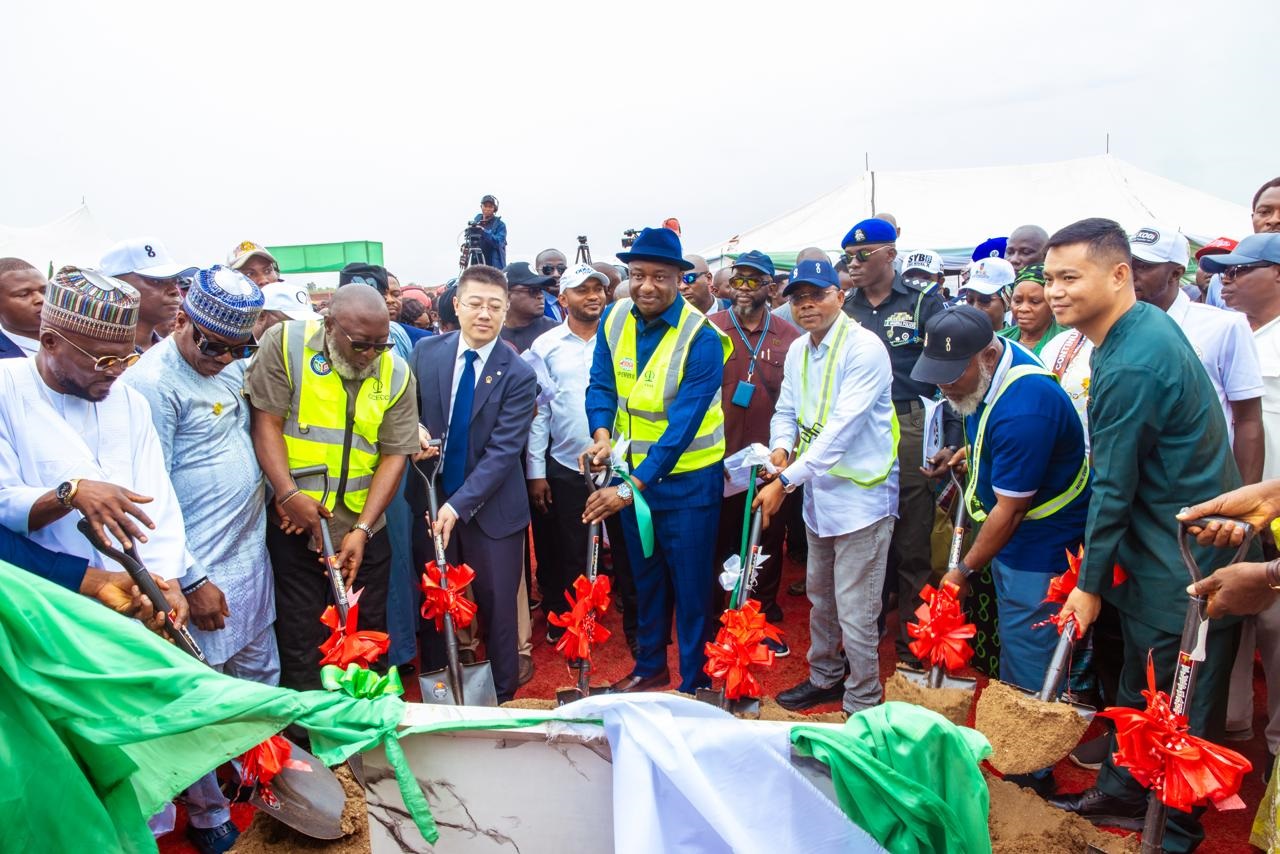
The construction of the Kogi International Airport at Zariagi is expected to open new opportunities for international trade and investment in the state, with the Minister of Aviation and Aerospace Development, Festus Keyamo, declaring that the project will put Kogi on the global aviation map.
Keyamo made the declaration on Monday during the official flag-off of the airport project, which he performed alongside Kogi State Governor, Alhaji Ahmed Usman Ododo.
The Minister described the development as a historic milestone, saying it would give Zariagi international recognition within the aviation community through the relevant airport identification and coding processes of the International Air Transport Association (IATA).
“What is happening here today, what the Governor has done today, will resonate many, many years, centuries after today, 500 years from today. Do you understand the significance of what is happening here today? Let me tell you the significance. Today, as from today, this village called Zariagi will be on the Global Aviation Map,” Keyamo declared.
He attributed the commencement of the project to the economic policies of President Bola Ahmed Tinubu and Governor Ododo’s vision and determination to translate available resources into meaningful development.
According to him, the Federal Government’s economic reforms, particularly the removal of fuel subsidy and the unification of the foreign exchange market, have increased allocations to state governments, providing them with greater financial capacity to undertake critical infrastructure projects.
The remarks were contained in a statement issued by Tunde Moshood, Special Adviser on Media and Communications to the Minister of Aviation and Aerospace Development.
Keyamo, however, stressed that increased revenue alone could not guarantee development without purposeful leadership and the ability to identify and invest in strategic projects.
“However, it takes two to tango. One, the positive policies of President Bola Ahmed Tinubu and the vision of the Governor. These are the two things that combined to make this thing possible today,” he said.
Addressing concerns over the rationale for establishing an international airport in Kogi State, the Minister argued that infrastructure development should not depend on the prior establishment of major businesses and commercial activities.
He maintained that an airport could attract international companies, hotels and other investments rather than waiting for such developments before providing aviation infrastructure.
“If you are waiting for the best international companies to be here, the best international hotels to be here before you put an airport, you wait for the next one million years, it will not come. It is the airport that attracts these developments. The airport is the precursor. The airport is the forerunner. The airport is the indicator of development,” Keyamo stated.
Earlier, Governor Ododo described the airport as a strategic investment in the economic future of Kogi State, saying it would help unlock the state’s agricultural and solid mineral resources for local and international markets.
He said the project would boost the transportation of agricultural produce and mineral resources, attract investors, stimulate commercial activities and create employment opportunities for residents.
The Governor also identified improved movement of people and goods, stronger connectivity and increased business activities as expected benefits of the project.
Kogi State has substantial solid mineral deposits, including iron ore, limestone, coal, marble, dolomite, feldspar, kaolin, gypsum and talc. Its agricultural products include cassava, rice, maize, cashew and palm oil.
Following their addresses, Keyamo and Ododo jointly performed the foundation-laying ceremony, formally signalling the commencement of construction.
The ceremony was attended by the NCAA Director of Public Affairs and Consumer Protection, Mr. Michael Achimugu; members of the Kogi State Executive Council; traditional rulers; the immediate past Deputy Governor of the state, Mr. Edward David Onoja; and other dignitaries.
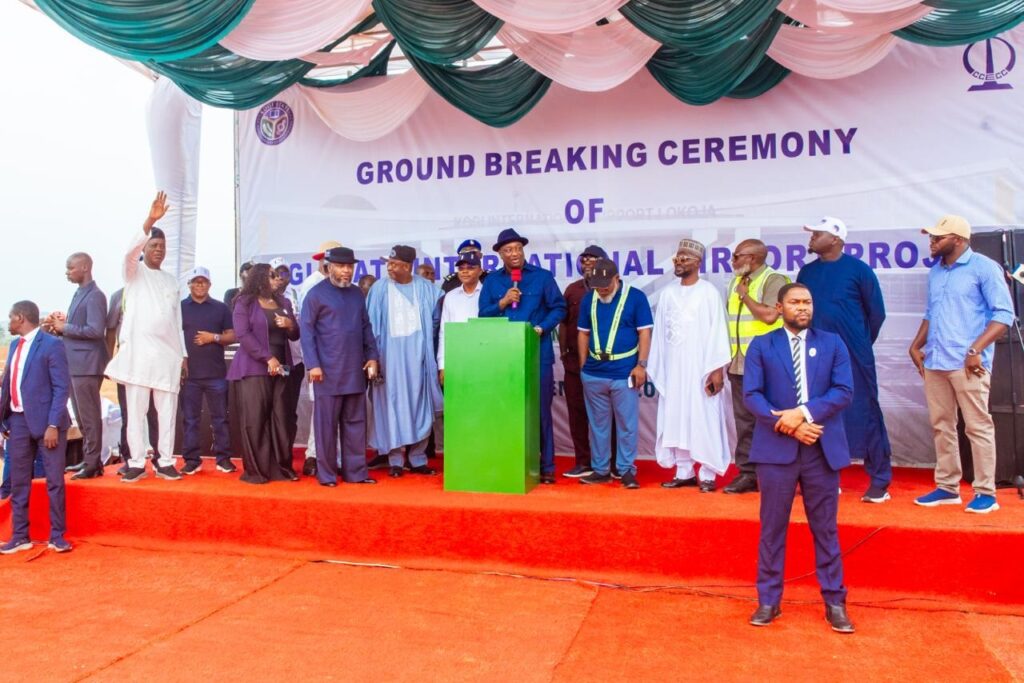
The Minister commended Ododo for his foresight and commitment to positioning Kogi State for greater economic relevance, expressing optimism that the project would deliver lasting benefits to the state and future generations.
Aviation
FAAN MD Urges Ghana to Localise Airport Strategy
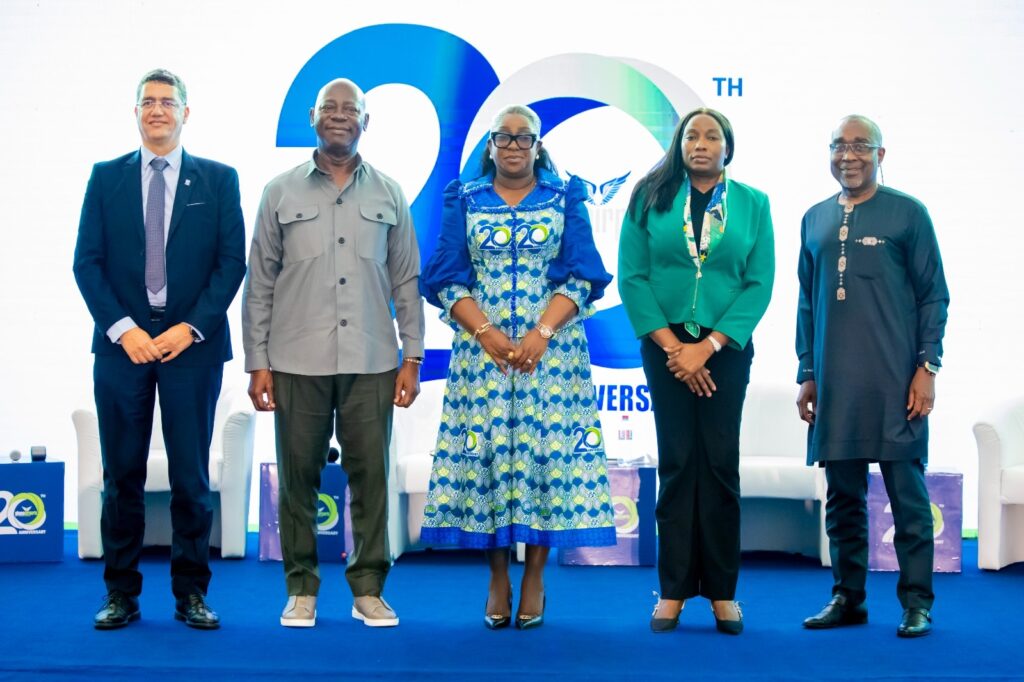
FAAN Managing Director, Mrs Olubunmi Onabanjo-Kuku, speaking during the 20th Anniversary Lecture and Awards of Ghana Airports Company Limited (GACL) in Ghana.

The Managing Director of the Federal Airports Authority of Nigeria (FAAN), Mrs. Olubunmi Onabanjo-Kuku, has urged Ghana to adopt market-driven and passenger-focused strategies in developing its airports, stressing that airport operations must be aligned with the broader economic needs of their host communities.
Onabanjo-Kuku, who made the call at the 20th anniversary lecture and awards of Ghana Airports Company Limited (GACL), challenged airport managers across Africa to move beyond measuring their performance through passenger traffic figures and recognise the wider economic contributions of aviation.
Speaking as a special guest and panellist at the event held on Monday, November 9, 2026, she urged GACL to “segment your market and localise your strategy” to maximise the economic potential of Ghana’s airports.
She argued that airports should not be developed in isolation from the economies they serve, noting that aviation’s contribution extends beyond direct employment and airport operations to other sectors of the economy.
“Aviation or airports globally contribute about 8.5 million jobs, but if you look at the indirect contribution, it’s about 65 million,” she said, adding that airport managers’ responsibilities go beyond activities within airport premises.
The FAAN chief, who oversees 22 airports in Nigeria, said she had stopped describing aviation merely as a mode of transportation because of its critical role in socio-economic development.
According to her, airport development strategies must reflect the economic realities and opportunities of individual locations rather than adopt a uniform approach across different markets.
She also emphasised the need to place passengers at the centre of airport operations, identifying affordable travel costs, safety and quality service delivery as essential elements of a competitive aviation industry.
“What’s important is to make sure that the cost of travel is reasonable and affordable, that the passengers are kept safe and that they have the best experience when travelling through the airports or through the aircraft that are provided by the airline,” she said.
On commercial development, Onabanjo-Kuku advised airport operators to understand the preferences and spending patterns of their respective markets before determining the services and concessions to provide.
She questioned the practice of offering similar commercial products across airports without considering local demand, arguing that passengers’ needs and purchasing preferences differ from one destination to another.
Addressing concerns over the cost of air travel, the FAAN managing director acknowledged that ticket prices comprise several components, including passenger service charges, security charges, government taxes, airline costs and Ghana’s newly introduced airport development charge.
She expressed willingness to work with her Ghanaian counterpart, GACL Managing Director, Yvonne Nana Afriyie Opare, to examine the various cost components and identify possible areas of cooperation and reductions.
“I’m happy to sit with my sister Yvonne and do a fair decomposition, because it’s not just the airport charge—there are other government taxes across both countries,” she said.
Onabanjo-Kuku also commended GACL for its resilience and resourcefulness in managing and developing Ghana’s airports over the past two decades, expressing confidence in the company’s capacity to achieve further growth.
The anniversary celebration, held under the theme, “A Legacy of Resilience, Developing Further, Serving Better,” featured a keynote address by Ghana’s Vice President, Jane Naana Opoku-Agyemang, who stressed the importance of safe and globally competitive airports.
The Chief of Staff to the President, Julius Debrah, attended as Special Guest of Honour, while Opare hosted the gathering.
The FAAN managing director concluded her remarks by reiterating her advice to Ghana’s airport managers to adopt strategies tailored to their markets, declaring: “Ghana, you’re already on track. I am leaving you with two phrases: segment your market and localise your strategy.”

The Nigerian Safety Investigation Bureau (NSIB) has released its preliminary report on the October 15 incident involving a Bombardier Challenger 604 aircraft whose passenger-crew door detached during initial climb after take-off from the Nnamdi Azikiwe International Airport, Abuja.
The report disclosed that all nine persons aboard the aircraft, operated by Triton Aviation Limited, escaped without injury after the flight crew declared an emergency and returned safely to the airport, although the aircraft sustained substantial damage.
The aircraft, with nationality and registration marks T7-SEI, was operating as flight DWC052 on a non-scheduled service from Abuja to the Murtala Muhammed International Airport, Lagos. Those on board comprised two flight crew members, one cabin crew member and six passengers.
According to the preliminary report, at approximately 17:19 local time, during the initial climb, the flight crew observed an abnormal increase in cabin altitude and suspected a pressurisation problem.
The captain subsequently instructed the cabin crew to double-check the main cabin door. However, as the cabin crew approached the passenger-crew door to inspect it, the door opened and detached from the aircraft.
The details were contained in a statement signed by the Director General and Chief Executive Officer of the NSIB, Captain Alex Badeh Jr.
Following the occurrence, the flight crew declared an emergency and coordinated with Abuja Air Traffic Control (ATC) for an immediate return to the airport.
The aircraft subsequently landed safely on Runway 22 at approximately 17:34 local time, with all nine occupants disembarking without injuries.
The NSIB said it deployed investigators to the site immediately after receiving notification of the incident on the same day to search for and recover the detached door and conduct post-occurrence assessments.
The detached door was later recovered from a cornfield in Gui Village, Abuja Municipal Area Council, approximately five miles southwest of the airport.
The Bureau said the preliminary report contains factual information established so far, including initial findings based on available evidence and immediate safety recommendations arising from safety issues identified during the investigation.
It, however, clarified that the report does not contain analysis or conclusions on the causes or contributing factors of the incident, as investigations are still ongoing.
The Bureau said it would publish its final report, containing its analysis, conclusions and further safety recommendations where necessary, upon completion of the investigation in accordance with Annex 13 to the Convention on International Civil Aviation.

The preliminary report is available for download on the NSIB website for members of the public and the media.

Air Peace Fixes ₦80,000 Fare for Military Personnel

Kogi Targets Global Trade Through Airport Project

FG, Labour Seal Port Harcourt Airport Concession Deal

Air Peace Expands Domestic Flight Schedule

Lufthansa Group to Bring Eurowings to Nigeria in 2027

Gateway International Airport Takes Off as Ogun Joins Nigeria’s Air Map
-
 Airlines5 months ago
Air Peace Expands Domestic Flight Schedule
-
 Airlines3 months ago
Lufthansa Group to Bring Eurowings to Nigeria in 2027
-
 Aviation1 year ago
Gateway International Airport Takes Off as Ogun Joins Nigeria’s Air Map
-
 Airlines1 year ago
₦100m Land Deal: Air Peace Backs Onyema’s Claim on Anambra Airport
-

 Aviation1 year ago
Nigeria, UAE Firm Sign Landmark Cargo Information Deal
-

 Airlines1 year ago
High Airfares, Hot Hotels: Nigeria’s Travel Paradox
-

 Airlines1 year ago
Aborted Take-off: Air Peace Assures Passengers of Safety on Abuja–Asaba Flight
-

 AIRPORTS1 year ago
MMA2 Named Nigeria’s Best Cargo Airport, Jibodu Honored