
Airlines
$4m Maintenance Bills: Ibom Air Boss Warns Nigeria’s Aviation Could Collapse
Acting CEO, Ibom Air – George Uriesi


Acting CEO of Ibom Air, George Uriesi, has raised serious concerns over Nigeria’s dependence on foreign aircraft maintenance, calling the practice “a costly scam” that threatens the survival of local airlines.
Speaking at the 2025 FAAN National Aviation Conference (FNAC), Uriesi disclosed that maintenance projects initially quoted at $1.5 million frequently escalate to between $3 million and $4 million per aircraft, making financial planning nearly impossible for local carriers.
“Each time we take our aircraft abroad for maintenance, we return with wildly inflated costs,” he said. “The system is designed to exploit us, and it is unsustainable.”
Uriesi stressed the urgency of investing in local maintenance, repair and overhaul (MRO) facilities to reduce costs and dependence on foreign operators.
“We must begin to maintain our aircraft in Nigeria, even if partially. The current model is wrecking the industry,” he said, noting that unpredictable billing and prolonged downtime abroad undermine profitability.
The Ibom Air chief further highlighted the stark financing disparities facing Nigerian airlines. While European carriers access loans at 3–4% over 15 years, Nigerian operators battle interest rates of up to 30% with repayment windows as short as seven years.
“A European airline may pay $100 monthly for a new aircraft; we pay $500,” he lamented.
The problem extends to other cost centres. Uriesi said insurance premiums for Nigerian airlines remain nearly double what global carriers pay, despite similar risk levels.
He also criticised the heavy tax and charge regime. A Lagos–Accra service attracts about $185 in levies, with an extra $11.50 soon to be added by the NCAA. When combined with ground handling, fuel, and landing fees, setting profitable ticket prices becomes nearly impossible.
Despite these pressures, Ibom Air has sustained an 88% compounded revenue growth since 2019. Uriesi praised recent ministerial efforts to ease aircraft-acquisition challenges but warned that deep structural obstacles still hamper industry growth.
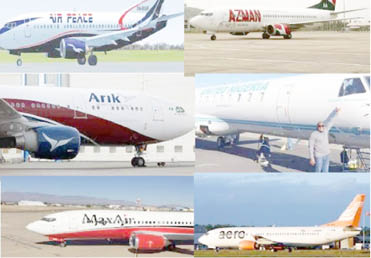
“The airline is the heavy lifter,” he said. “We earn in naira and pay in dollars. Every inefficiency eventually lands on the airline,”
Uriesi concluded that addressing aircraft maintenance inefficiencies, alongside other systemic hurdles, could dramatically improve the financial health of Nigerian airlines “almost overnight.”
Airlines
United Nigeria Airlines Targets January Cargo Flights at Ekiti
United Nigeria Airlines Fleet

United Nigeria Airlines (UNA) plans to commence commercial cargo operations at Ekiti Airport in January 2027, with daily passenger services also in the pipeline as the state government advances infrastructure upgrades.
The airline’s Chairman, Prof. Obiora Okonkwo, announced the plan on Monday during the commissioning of Reeve Energy Limited’s aviation fuel tank farm at the airport, saying the carrier was ready to support the movement of agricultural produce and other goods from Ekiti to markets across Nigeria and, eventually, overseas.
Okonkwo said the airline would be ready to commence cargo services once the state government was prepared to begin commercial exports from the airport. He pledged that United Nigeria Airlines would be the first carrier to lift commercial cargo from the facility when operations begin.
“By January next year, we will activate a cargo section of our flights so that we can work out a deal. As soon as you are ready to start exporting cargo from here, whether to other parts of Nigeria or beyond, we will be ready,” he said.
He added that the airline intended to introduce daily passenger flights to Ekiti, subject to the completion of ongoing airport infrastructure improvements.
The airline chairman described the commissioning of the fuel tank farm as an important development that would support flight operations and provide a foundation for future expansion at the airport.
Okonkwo said reliable aviation fuel supply was particularly important to the airline, which he described as Nigeria’s second-largest consumer of aviation fuel after Air Peace.
He explained that the Ekiti State Government selected United Nigeria Airlines for the partnership after assessing the operational capacity and fleet strength of domestic airlines, rather than following an application or lobbying process by the carrier.
According to him, the airline had sustained its commitment to the state by maintaining services even during periods of low passenger demand.
Ekiti State Governor, Biodun Oyebanji, said his administration was committed to completing the airport’s ongoing infrastructure projects by the end of 2026 to improve its operational capacity and attract further private-sector investment.
Oyebanji said the planned improvements included an upgrade of the airport’s Instrument Landing System (ILS) and the installation of aerodrome ground lighting to support operations beyond daylight hours.
He put the estimated cost of the ground lighting project at more than ₦10 billion, adding that the completed system would enable aircraft to land at the airport at any time, subject to applicable operational and regulatory requirements.
The governor also disclosed that the state government was pursuing an Independent Power Producer arrangement to ensure a reliable electricity supply for the airport and reduce dependence on external power sources.
He commended Reeve Energy Limited for investing in the state and reaffirmed his administration’s commitment to providing an enabling environment for businesses.
The planned cargo service could open additional routes for Ekiti’s agricultural produce and other goods, while the proposed daily passenger flights would improve the state’s air connectivity. Their implementation will depend on cargo-export readiness, infrastructure completion and the relevant operational requirements.
United Nigeria Airlines is planning to raise ₦20 billion through its maiden commercial paper issuance to finance expansion of its domestic, regional and international operations, potentially becoming Nigeria’s first domestic airline to access the short-term debt market through the instrument.
The proposed fundraising will be conducted under Series 1 and 2 of the airline’s ₦100 billion commercial paper programme, with maturity periods of 270 days and 364 days, respectively.
According to the airline’s September 2026 investor presentation, the issuance is part of efforts to strengthen its financial position and provide funding for its expansion plans.
Meristem Capital Limited is the lead arranger for the transaction, while Cordros Advisory Services Limited, Coronation Merchant Bank Limited, FCMB Capital Markets Limited, FSL Advisory Limited and Quantum Zenith Capital & Investments Limited will serve as dealers.
To support the fundraising, the airline has obtained credit ratings from Agusto & Co. and DataPro, with both agencies assigning ratings to its short-term and long-term credit profiles.
Agusto & Co. assigned United Nigeria Airlines short-term and long-term ratings of A3 and BBB-, respectively, both with a stable outlook. DataPro assigned short-term and long-term ratings of A1 and BBB, respectively.
The proposed issuance comes as the airline reports significant revenue growth over the past five years. Its revenue increased from ₦10.3 billion in 2021 to ₦90.8 billion in 2025, while profit after tax rose from ₦1.3 billion to ₦23.8 billion over the same period.
The investor presentation also showed that revenue reached ₦95.6 billion in the first half of 2026.
The airline recorded improved financial performance in August, with turnover rising to ₦19.4 billion from ₦14.1 billion in July. It also returned to a net profit of ₦1.2 billion during the month.
The company expressed optimism that its performance would continue to improve in the remaining months of 2026 and beyond.
United Nigeria Airlines currently operates a fleet of 10 aircraft comprising Embraer ERJ-145, Boeing 737-800, Embraer E190 and CRJ900 aircraft. It plans to take delivery of six additional aircraft before the end of the year to support its growth strategy.
The airline serves 14 destinations across Nigeria and Ghana and has secured approval to operate as a flag carrier to six international destinations.
As part of efforts to expand its market reach and improve access to its services, the carrier has also signed agreements with global distribution systems Amadeus and Sabre, enabling travel agents worldwide to access its ticket inventory and book its flights.
United Nigeria Airlines has maintained International Air Transport Association Operational Safety Audit certification since 2022 and is an IATA member.
In 2026, the airline signed the IATA Multilateral Interline Traffic Agreement, which facilitates cooperation among airlines in handling connecting journeys, and became a full member of the African Airlines Association.
The planned commercial paper issuance would provide the airline with an additional funding channel as it pursues fleet expansion and seeks to strengthen its presence in domestic and international markets.
Airlines
NSIB Probes Challenger 604 Door Separation After Mayday
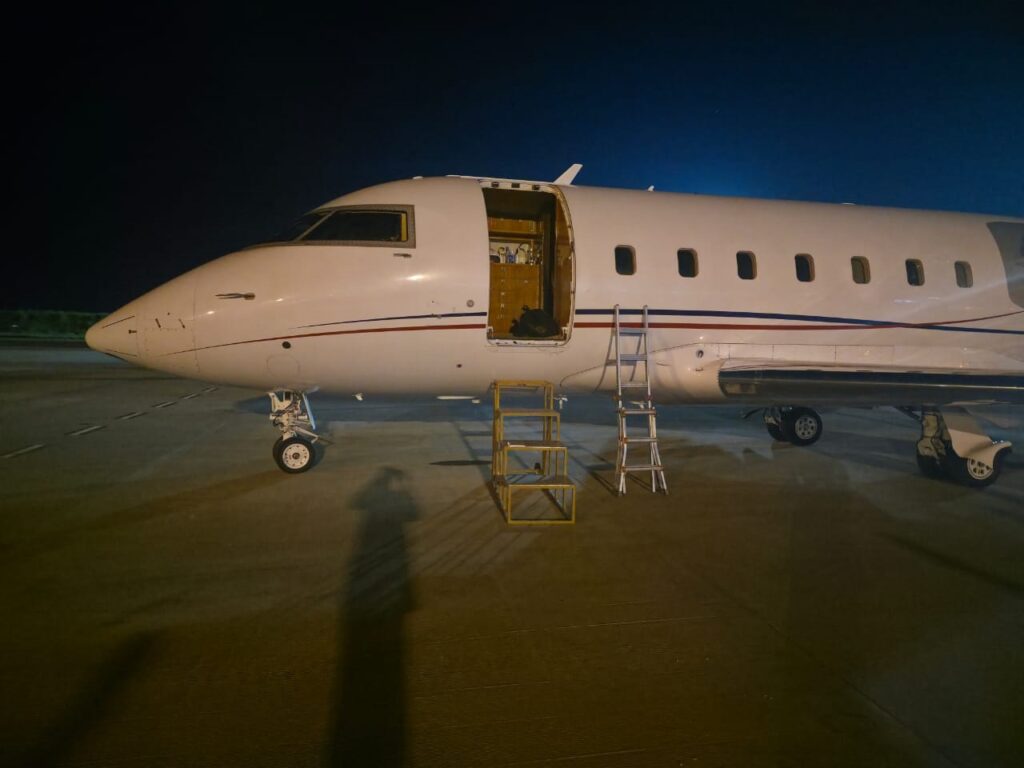
The Challenger 604 aircraft operated by Triton, which returned safely to Abuja after its door separated shortly after take-off for Lagos.
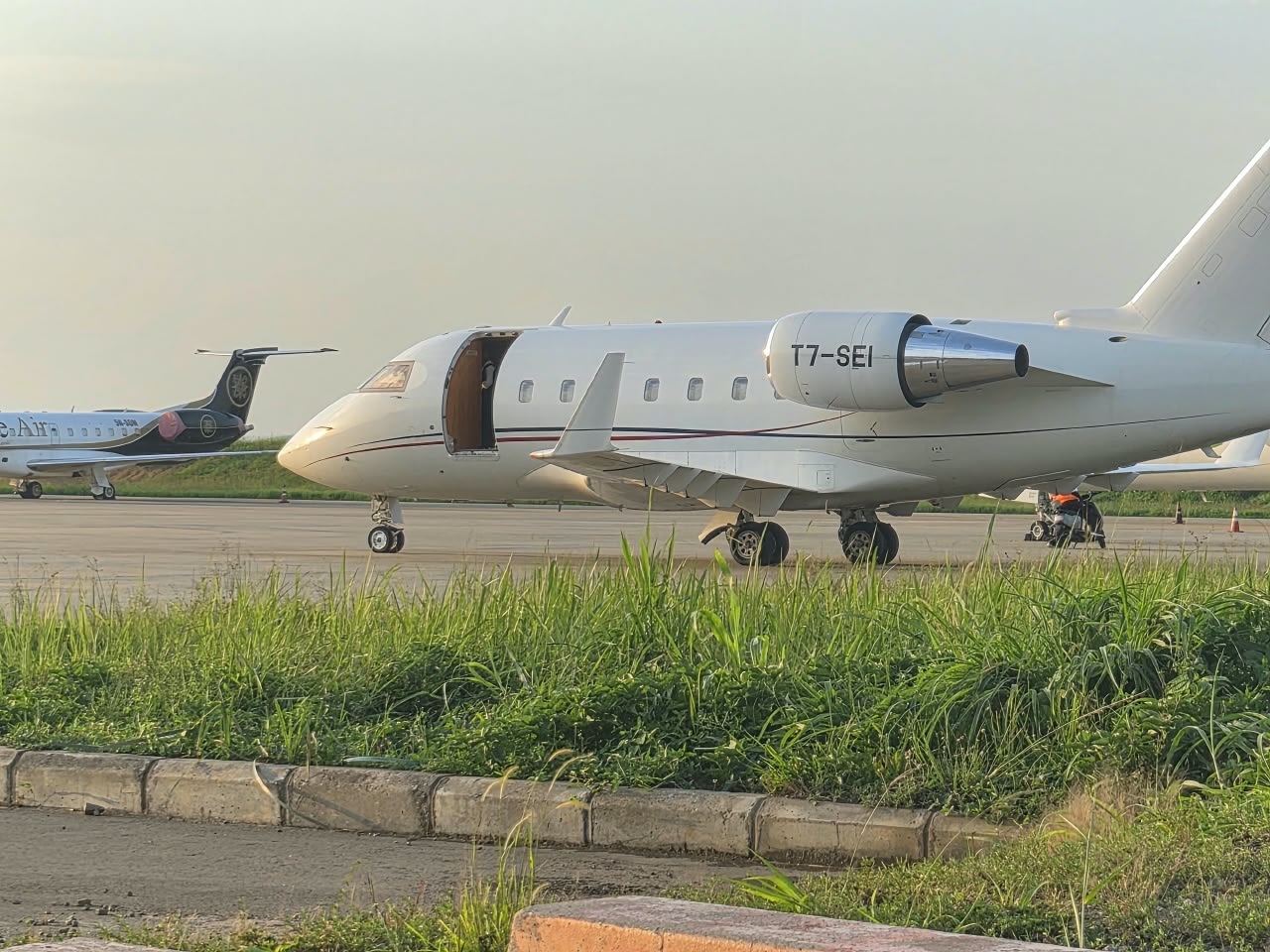
The Nigerian Safety Investigation Bureau (NSIB) has commenced an investigation into an aviation occurrence involving a Challenger 604 aircraft operated by Triton after its door separated shortly after departure from Abuja, forcing the crew to declare a mayday and return to the airport.
The aircraft, with registration number T7-SEI, was en route to Lagos when the incident occurred at three nautical miles from Abuja, while passing 3,500 feet.
According to the NSIB, the aircraft departed Abuja at 1612 UTC on October 16, 2026, but the crew declared a mayday following the door separation.
In a statement signed by the Director-General and Chief Executive Officer of the NSIB, Captain Alex Badeh Jr., the Bureau said the aircraft returned to Abuja and landed safely on Runway 22 at 1634 UTC.
The aircraft had nine persons on board, comprising three crew members and six passengers.
The NSIB said the separated door had been recovered and secured at its wreckage hangar as part of efforts to establish the circumstances surrounding the occurrence.
The Bureau said its investigation had commenced and that further updates would be provided as the process progressed.

FG Pushes Gulf of Guinea Policy to Curb Illegal Fishing

NIWA Orders Quarterly Boat Checks, Targets 80% Cut in Accidents

Ebola Alert: FAAN Strengthens Airport Vigilance, Urges Calm

Air Peace Expands Domestic Flight Schedule

Lufthansa Group to Bring Eurowings to Nigeria in 2027

Gateway International Airport Takes Off as Ogun Joins Nigeria’s Air Map
-
 Airlines4 months ago
Air Peace Expands Domestic Flight Schedule
-
 Airlines2 months ago
Lufthansa Group to Bring Eurowings to Nigeria in 2027
-
 Aviation1 year ago
Gateway International Airport Takes Off as Ogun Joins Nigeria’s Air Map
-

 Airlines1 year ago
₦100m Land Deal: Air Peace Backs Onyema’s Claim on Anambra Airport
-

 Aviation1 year ago
Nigeria, UAE Firm Sign Landmark Cargo Information Deal
-

 Airlines1 year ago
High Airfares, Hot Hotels: Nigeria’s Travel Paradox
-
 Airlines1 year ago
UK Partnership Opens Heathrow, Gatwick Gates for Air Peace – Onyema
-

 AIRPORTS1 year ago
MMA2 Named Nigeria’s Best Cargo Airport, Jibodu Honored