
AIRPORTS
Keyamo Inspects Abuja Airport Gates as Hybrid Payment Eases Traffic
Aviation Minister – Mr. Festus Keyamo SAN


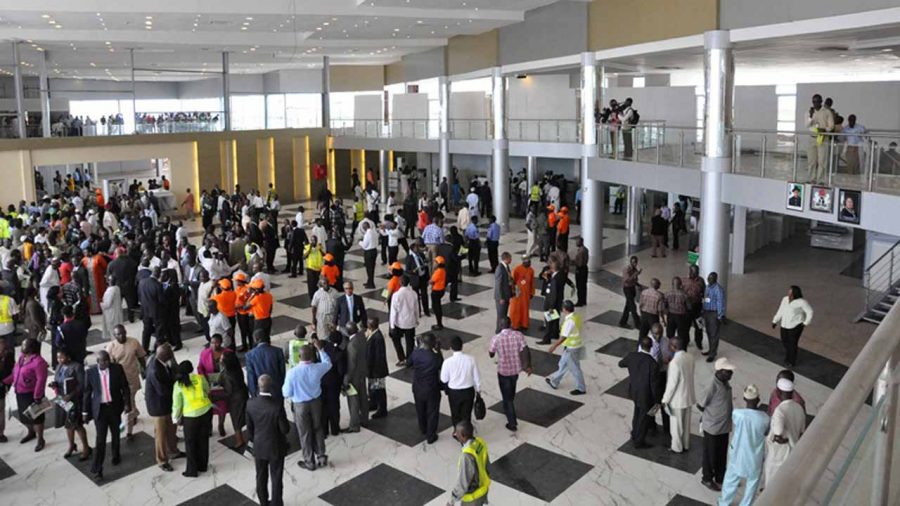
The Minister of Aviation and Aerospace Development, Festus Keyamo, on Friday inspected the access gates at Nnamdi Azikiwe International Airport in Abuja to evaluate the effectiveness of the newly introduced hybrid payment system for vehicles entering the airport.
The visit, which took place on March 13, 2026, followed the Federal Government’s directive restoring a hybrid arrangement that allows both cash and electronic payments at the airport gates.
The decision came after the earlier suspension of the fully cashless system in line with directives from Bola Ahmed Tinubu.
During the inspection, the Minister monitored traffic movement at the entry points and interacted with officials of the Federal Airports Authority of Nigeria (FAAN), who are overseeing the implementation of the revised payment structure.
Keyamo expressed satisfaction with the improved traffic flow recorded since the introduction of the hybrid option, noting that the change has significantly reduced congestion around the airport entrance.
He commended the Managing Director and Chief Executive Officer of FAAN, Olubunmi Kuku, and her management team for their quick response in adjusting operations to ensure smoother vehicular access to the airport.
According to the Minister, the hybrid payment system is a temporary arrangement while the Ministry continues discussions with concessionaires on the deployment of a fully automated and electronic access gate system across the country’s airports.
Keyamo also revealed that further operational improvements are being considered, including the introduction of dedicated lanes for vehicles making cash payments to prevent traffic build-up at the gates.

The inspection, he said, reflects the Federal Government’s determination to improve airport access, reduce congestion, and enhance the overall travel experience for passengers and other airport users.
The Federal Airports Authority of Nigeria (FAAN) has unveiled plans to introduce a biometric passenger verification system, V-Pass, aimed at transforming domestic air travel by speeding up passenger processing, strengthening airport security and reducing reliance on physical identity documents.
The facial recognition platform, developed in partnership with M/S Verxid Technologies Limited, will provide travellers with a secure digital identity that enables seamless verification at key airport checkpoints before accessing restricted areas and boarding aircraft.
The initiative was reviewed during a strategic meeting between FAAN and Verxid Technologies Limited, where both organisations discussed deployment strategies, security measures and implementation plans designed to improve passenger experience across Nigeria’s domestic airports.
According to a statement signed by FAAN’s Director of Public Affairs and Consumer Protection, Henry Agbebire, the meeting focused on ensuring the successful deployment of the digital identity platform while maintaining the highest standards of aviation security.
FAAN’s Director of Commercial and Business Development, Ms Adebola, described the project as another milestone in the Authority’s digital transformation programme, saying the introduction of V-Pass underscores FAAN’s commitment to deploying innovative technology that enhances passenger facilitation and aviation security.
She explained that Nigerian passengers will complete a one-time enrolment using their National Identification Number (NIN) and facial biometric capture, while foreign travellers will register with their international passports through Optical Character Recognition (OCR) and biometric authentication.
Once enrolled, passengers will undergo biometric verification before entering restricted airport areas and again before boarding their flights, a dual-authentication process designed to eliminate impersonation, identity fraud and unauthorised access.
The system will feature electronic gates and self-service kiosks to automate passenger processing, while trained FAAN personnel will be available to assist travellers where necessary.
FAAN said first-time enrolment is expected to take about one minute, while subsequent facial verification will be completed in less than 30 seconds, significantly reducing queues and improving passenger movement within airport terminals.
Beyond passenger processing, the platform will provide airlines with secure digital access to flight schedules, passenger manifests and boarding statistics, while FAAN’s Central Management System will enable real-time monitoring of passenger movement, operational analytics and future integration with other airport management systems.
The Authority assured passengers that data privacy remains a top priority, noting that the platform fully complies with the Nigeria Data Protection Regulation (NDPR). It added that no passenger information will be stored on self-service kiosks or handheld verification devices.
Ahead of nationwide deployment, FAAN and Verxid Technologies Limited will commence a comprehensive public awareness campaign through television, radio, social media, airport public address systems and airline advisories to educate passengers on the operation and benefits of the new platform.
A live Proof of Concept demonstration and technical site assessment will also be conducted before the system is fully rolled out across the country’s domestic airports.
FAAN said the initiative forms a key part of its broader digital transformation agenda and is expected to deliver smarter, safer and more efficient passenger processing while aligning Nigeria’s domestic airports with evolving global standards in aviation security and passenger facilitation.
AIRPORTS
FG Concessions Enugu Airport to Private Operator
Minister of Aviation and Aerospace Development, Festus Keyamo (centre), signs the concession agreement for the Akanu Ibiam International Airport during the official handover ceremony in Enugu on Tuesday.

The Federal Government on Tuesday formally concessioned the Akanu Ibiam International Airport to Aero Alliance Limited under a Public-Private Partnership (PPP) arrangement, marking what it described as a major milestone in the country’s airport modernisation programme.
The concession agreement was signed by the Minister of Aviation and Aerospace Development, Festus Keyamo, during a ceremony at the airport’s new terminal attended by senior government officials, aviation stakeholders and representatives of the private sector.
Speaking at the event, Keyamo said the concession ended more than two decades of unsuccessful attempts to attract private investment to the airport, attributing the breakthrough to the reform agenda of President Bola Ahmed Tinubu.
According to the minister, previous investors concentrated on airports in Lagos, Abuja and Kano, while Enugu and Port Harcourt attracted little interest.
He disclosed that the successful concession of Enugu had renewed investor confidence in Nigeria’s aviation sector, adding that Port Harcourt International Airport would also be concessioned within the next few weeks, while bids were already being prepared for three additional airports.
Keyamo commended the Governor of Enugu State, Peter Ndubuisi Mbah, for facilitating investor participation in the project, describing him as a key partner in bringing the concession to fruition.
Addressing concerns by aviation workers, the minister assured employees that their jobs and welfare would remain protected under the concession arrangement, although the airport would now operate under stricter efficiency and accountability standards.
He urged Aero Alliance Limited to justify the Federal Government’s confidence by delivering world-class airport management, noting that its performance would serve as a benchmark for future airport concessions across the country.
Keyamo also revealed that the Enugu State Government had signed a Memorandum of Understanding to facilitate direct flight services between Guangzhou and Enugu, a move expected to strengthen trade, tourism and investment in the South-East.
In his remarks, Governor Mbah described the concession as a major step towards transforming Enugu into a regional aviation, logistics and investment hub.

The ceremony concluded with the formal signing of concession documents, transferring the airport’s operational and management responsibilities to Aero Alliance Limited.
AIRPORTS
Keyamo Positions Lagos as Africa’s Next Aviation Hub
Nigeria’s Minister of Aviation and Aerospace Development, Festus Keyamo, delivers his keynote address at the Invest Lagos 3.0 Summit in Lagos, where he unveiled plans to position the state as Africa’s next major aviation hub and investment destination on Monday

The Federal Government has intensified efforts to position Lagos as Africa’s leading aviation hub, with Minister of Aviation and Aerospace Development, Festus Keyamo, unveiling major infrastructure projects and investment opportunities aimed at transforming the city into a global gateway for air transport and commerce.
Speaking at the opening of the Invest Lagos 3.0 Summit in Lagos, Keyamo called on international investors to take advantage of the vast opportunities in Nigeria’s aviation sector, describing Lagos as the natural hub for regional and intercontinental connectivity.
The three-day summit, convened by Lagos State Governor Babajide Sanwo-Olu, attracted global investors, business leaders, policymakers and development partners. The event was chaired by Vice President Kashim Shettima and attended by governors from several states and other top government officials.
Highlighting Lagos’ strategic importance, the minister disclosed that about 67 per cent of all international air passengers entering Nigeria arrive through Lagos, reinforcing its status as the country’s foremost aviation gateway.
According to him, Lagos’ geographical location provides a significant advantage, placing major destinations in Europe, the Middle East, Southern Africa and South America within approximately six hours of flight time.
“Lagos is strategically positioned to become a major aviation hub connecting Africa with the rest of the world,” Keyamo said.
The minister revealed that President Bola Tinubu has approved a $500 million investment for the comprehensive reconstruction and modernization of the Murtala Muhammed International Airport, Lagos.
He said the project would transform the over 50-year-old airport into a world-class facility capable of competing with leading aviation hubs on the continent.
“This is an investment from the nation’s resources to create a modern airport that Nigerians will be proud of. Within the next twenty-two months, the transformation will be evident to all,” he stated.
Keyamo also announced plans to improve access to the airport through the extension of the Lagos rail network. He said the Federal Ministry of Aviation and Aerospace Development is working with the Lagos State Government to connect the rail line from Ikeja to the General Aviation Terminal, MM2 and the international terminal.
The rail project, he explained, will improve passenger movement, reduce travel time and strengthen Lagos’ position as a preferred destination for air travellers and investors.
The minister further assured investors of the Federal Government’s commitment to protecting investments and fostering a business-friendly environment, citing the successful resolution of a long-standing dispute involving a private airport investor as evidence of the administration’s support for private sector participation.
He urged investors attending the summit to explore opportunities in both federal aviation infrastructure projects and the proposed airport development along the Lekki corridor.

Keyamo expressed confidence that ongoing reforms and infrastructure investments would enable Lagos to rival some of Africa’s most established aviation centres while reinforcing Nigeria’s position as a leading destination for trade, tourism and investment.

NCAA Maps Out Eight-Pillar Aviation Strategy

FAAN Rolls Out Biometric V-Pass for Faster, Safer Domestic Air Travel

FLIDAN Pushes Stronger Flight Dispatch Standards to Boost Aviation Safety

Air Peace Expands Domestic Flight Schedule

Gateway International Airport Takes Off as Ogun Joins Nigeria’s Air Map

Nigeria, UAE Firm Sign Landmark Cargo Information Deal
-
 Airlines1 month ago
Air Peace Expands Domestic Flight Schedule
-
 Aviation10 months ago
Gateway International Airport Takes Off as Ogun Joins Nigeria’s Air Map
-
 Aviation10 months ago
Nigeria, UAE Firm Sign Landmark Cargo Information Deal
-

 Airlines10 months ago
₦100m Land Deal: Air Peace Backs Onyema’s Claim on Anambra Airport
-
 Airlines10 months ago
UK Partnership Opens Heathrow, Gatwick Gates for Air Peace – Onyema
-

 Airlines10 months ago
High Airfares, Hot Hotels: Nigeria’s Travel Paradox
-

 AIRPORTS10 months ago
MMA2 Named Nigeria’s Best Cargo Airport, Jibodu Honored
-

 Airlines10 months ago
Aborted Take-off: Air Peace Assures Passengers of Safety on Abuja–Asaba Flight