
Airlines
Airlines, Labour Clash Over N5% TSC
The AON spokesperson and Chairman of United Nigeria Airlines, Prof. Obiora Okonkwo


*Okonkwo reveals 30% waiver, cites soaring fuel costs
*ATSSSAN insists airlines cannot withhold statutory levy
A fresh battle over billions of naira in statutory aviation revenue erupted at the 30th annual conference of the League of Aviation and Airport Correspondents (LAAC) in Lagos, as domestic airline operators and aviation unions engaged in a heated confrontation over the controversial five per cent Ticket Sales Charge (TSC).
The dispute centred on whether airlines, already struggling with escalating operating costs, can withhold or delay remittance of the levy, which is collected from passengers and transferred to government aviation agencies.
The sharp exchange exposed the widening fault line between financially pressured airlines and organised labour, which insists that statutory aviation charges cannot be treated as negotiable obligations.
Speaking for the Airline Operators of Nigeria (AON), Executive Chairman of United Nigeria Airlines, Prof. Obiora Okonkwo, said airlines had previously met their statutory financial obligations but began experiencing difficulties as operating costs surged.
Okonkwo, who spoke on the conference theme, “Towards a Sustainable Aviation Industry: Balancing Government Revenue Demands with Sector Growth,” attributed the payment challenges largely to the dramatic increase in aviation fuel prices.
He said the price of aviation fuel rose to about N3,300, following what he described as the Gulf crisis, putting further pressure on already cash-strapped airlines.
According to him, AON was the first to formally approach the Federal Government over the burden of regulatory charges and seek relief for operators.
“Before February this year, there were no payment problems. All airlines were paying. The AON issue only became a problem because of the Gulf crisis. AON was the first to cry out. We wrote to the President, explaining that we could no longer pay these charges,” he said.
Okonkwo disclosed that the Federal Government subsequently granted airlines a 30 per cent waiver on the charges.
He explained that following the waiver, airline operators held several meetings with the NCAA and the Ministry of Aviation to agree on a structured repayment plan for outstanding obligations.
He said the NCAA subsequently requested that airlines pay 10 per cent of their legacy debts within an agreed period, with the balance to be paid in instalments, while individual airlines were expected to meet with the authority’s Director of Finance.
But the operators’ position triggered a strong reaction from organised labour.
Secretary-General of the Air Transport Services Senior Staff Association of Nigeria (ATSSSAN), Francis Akinjole, rejected any suggestion that the five per cent TSC was subject to negotiation by airlines.
Akinjole described the operators’ position as “mischievous”, insisting that the levy was established by law and could only be changed through the appropriate legislative process.
“We heard them very well. They are saying the five per cent TSC is not justifiable, but it is not the making of the DG NCAA or the Minister. That payment was established by an Act; so they know where to go,” he said.
“They are just trying to find what does not exist to stop what already exists. They are being very, very mischievous.”
The union leader maintained that financial difficulties could not give airlines the right to determine which statutory obligations they would comply with.
“This is an Act; it is the law. You cannot say that because things are hard for you, you will then choose which law to obey,” Akinjole said.
He argued that any attempt to discontinue the levy would require the appropriate legislative process, including a public hearing.
The unions further warned that non-remittance of the TSC could have serious implications for aviation safety and the welfare of workers across the sector.
They maintained that airlines are merely collection agents for the levy, which is paid by passengers and belongs to the government’s aviation safety and regulatory system.
The confrontation has now brought the long-running dispute over outstanding statutory remittances into sharper focus, with the competing demands of airline survival, government revenue and aviation safety becoming increasingly difficult to reconcile.
For an industry already battling high fuel costs, foreign exchange pressures and other operational challenges, the TSC controversy presents another major test of the Federal Government’s ability to balance revenue collection with the financial survival of domestic airlines.

The explosive exchange at the LAAC conference may therefore have opened a new chapter in the dispute, with pressure mounting on aviation authorities to broker a lasting solution before the disagreement further strains relations between operators, regulators and organised labour
Airlines
United Nigeria Airlines Targets January Cargo Flights at Ekiti
United Nigeria Airlines Fleet

United Nigeria Airlines (UNA) plans to commence commercial cargo operations at Ekiti Airport in January 2027, with daily passenger services also in the pipeline as the state government advances infrastructure upgrades.
The airline’s Chairman, Prof. Obiora Okonkwo, announced the plan on Monday during the commissioning of Reeve Energy Limited’s aviation fuel tank farm at the airport, saying the carrier was ready to support the movement of agricultural produce and other goods from Ekiti to markets across Nigeria and, eventually, overseas.
Okonkwo said the airline would be ready to commence cargo services once the state government was prepared to begin commercial exports from the airport. He pledged that United Nigeria Airlines would be the first carrier to lift commercial cargo from the facility when operations begin.
“By January next year, we will activate a cargo section of our flights so that we can work out a deal. As soon as you are ready to start exporting cargo from here, whether to other parts of Nigeria or beyond, we will be ready,” he said.
He added that the airline intended to introduce daily passenger flights to Ekiti, subject to the completion of ongoing airport infrastructure improvements.
The airline chairman described the commissioning of the fuel tank farm as an important development that would support flight operations and provide a foundation for future expansion at the airport.
Okonkwo said reliable aviation fuel supply was particularly important to the airline, which he described as Nigeria’s second-largest consumer of aviation fuel after Air Peace.
He explained that the Ekiti State Government selected United Nigeria Airlines for the partnership after assessing the operational capacity and fleet strength of domestic airlines, rather than following an application or lobbying process by the carrier.
According to him, the airline had sustained its commitment to the state by maintaining services even during periods of low passenger demand.
Ekiti State Governor, Biodun Oyebanji, said his administration was committed to completing the airport’s ongoing infrastructure projects by the end of 2026 to improve its operational capacity and attract further private-sector investment.
Oyebanji said the planned improvements included an upgrade of the airport’s Instrument Landing System (ILS) and the installation of aerodrome ground lighting to support operations beyond daylight hours.
He put the estimated cost of the ground lighting project at more than ₦10 billion, adding that the completed system would enable aircraft to land at the airport at any time, subject to applicable operational and regulatory requirements.
The governor also disclosed that the state government was pursuing an Independent Power Producer arrangement to ensure a reliable electricity supply for the airport and reduce dependence on external power sources.
He commended Reeve Energy Limited for investing in the state and reaffirmed his administration’s commitment to providing an enabling environment for businesses.
The planned cargo service could open additional routes for Ekiti’s agricultural produce and other goods, while the proposed daily passenger flights would improve the state’s air connectivity. Their implementation will depend on cargo-export readiness, infrastructure completion and the relevant operational requirements.
United Nigeria Airlines is planning to raise ₦20 billion through its maiden commercial paper issuance to finance expansion of its domestic, regional and international operations, potentially becoming Nigeria’s first domestic airline to access the short-term debt market through the instrument.
The proposed fundraising will be conducted under Series 1 and 2 of the airline’s ₦100 billion commercial paper programme, with maturity periods of 270 days and 364 days, respectively.
According to the airline’s September 2026 investor presentation, the issuance is part of efforts to strengthen its financial position and provide funding for its expansion plans.
Meristem Capital Limited is the lead arranger for the transaction, while Cordros Advisory Services Limited, Coronation Merchant Bank Limited, FCMB Capital Markets Limited, FSL Advisory Limited and Quantum Zenith Capital & Investments Limited will serve as dealers.
To support the fundraising, the airline has obtained credit ratings from Agusto & Co. and DataPro, with both agencies assigning ratings to its short-term and long-term credit profiles.
Agusto & Co. assigned United Nigeria Airlines short-term and long-term ratings of A3 and BBB-, respectively, both with a stable outlook. DataPro assigned short-term and long-term ratings of A1 and BBB, respectively.
The proposed issuance comes as the airline reports significant revenue growth over the past five years. Its revenue increased from ₦10.3 billion in 2021 to ₦90.8 billion in 2025, while profit after tax rose from ₦1.3 billion to ₦23.8 billion over the same period.
The investor presentation also showed that revenue reached ₦95.6 billion in the first half of 2026.
The airline recorded improved financial performance in August, with turnover rising to ₦19.4 billion from ₦14.1 billion in July. It also returned to a net profit of ₦1.2 billion during the month.
The company expressed optimism that its performance would continue to improve in the remaining months of 2026 and beyond.
United Nigeria Airlines currently operates a fleet of 10 aircraft comprising Embraer ERJ-145, Boeing 737-800, Embraer E190 and CRJ900 aircraft. It plans to take delivery of six additional aircraft before the end of the year to support its growth strategy.
The airline serves 14 destinations across Nigeria and Ghana and has secured approval to operate as a flag carrier to six international destinations.
As part of efforts to expand its market reach and improve access to its services, the carrier has also signed agreements with global distribution systems Amadeus and Sabre, enabling travel agents worldwide to access its ticket inventory and book its flights.
United Nigeria Airlines has maintained International Air Transport Association Operational Safety Audit certification since 2022 and is an IATA member.
In 2026, the airline signed the IATA Multilateral Interline Traffic Agreement, which facilitates cooperation among airlines in handling connecting journeys, and became a full member of the African Airlines Association.
The planned commercial paper issuance would provide the airline with an additional funding channel as it pursues fleet expansion and seeks to strengthen its presence in domestic and international markets.
Airlines
NSIB Probes Challenger 604 Door Separation After Mayday
The Challenger 604 aircraft operated by Triton, which returned safely to Abuja after its door separated shortly after take-off for Lagos.
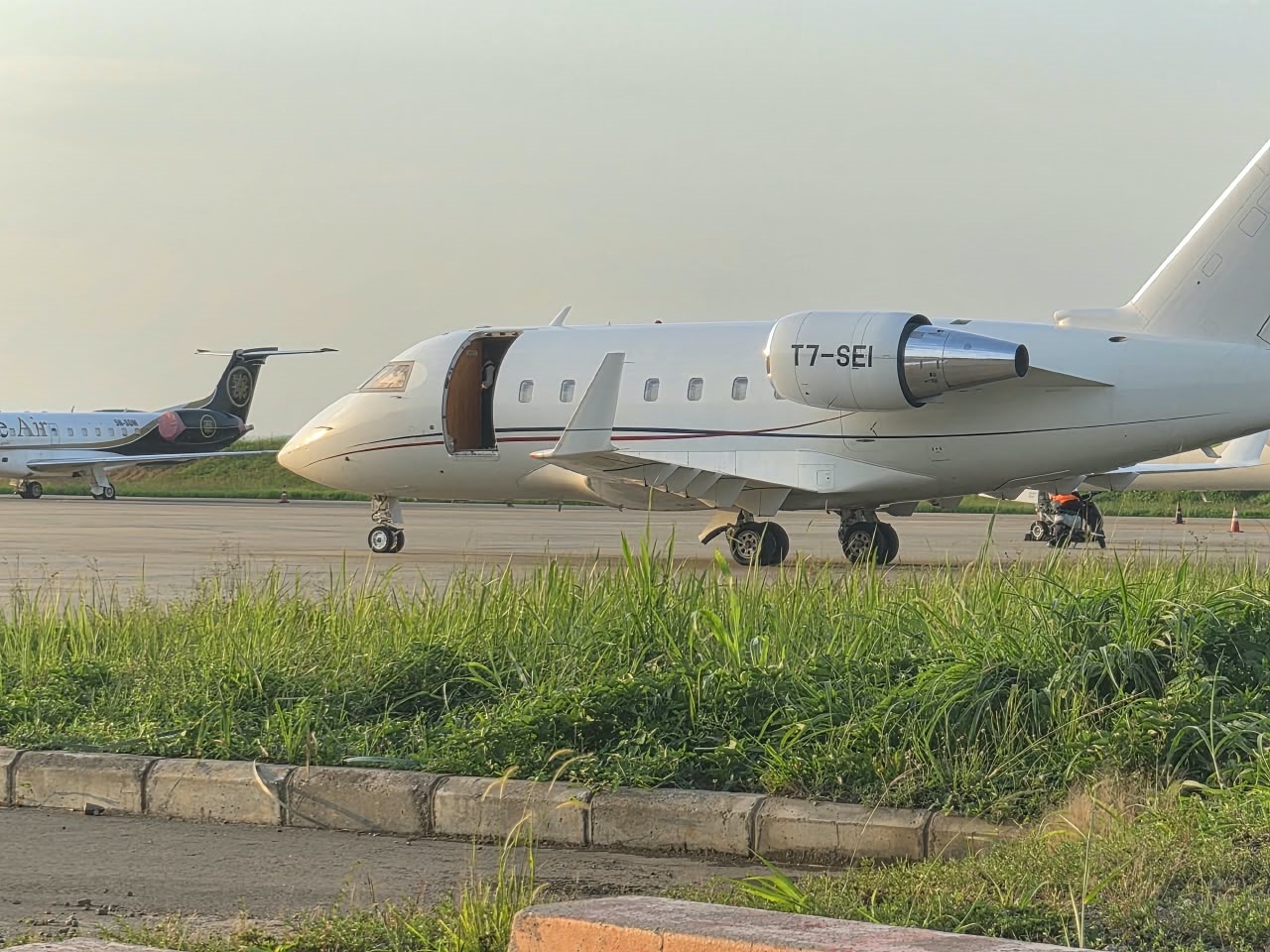
The Nigerian Safety Investigation Bureau (NSIB) has commenced an investigation into an aviation occurrence involving a Challenger 604 aircraft operated by Triton after its door separated shortly after departure from Abuja, forcing the crew to declare a mayday and return to the airport.
The aircraft, with registration number T7-SEI, was en route to Lagos when the incident occurred at three nautical miles from Abuja, while passing 3,500 feet.
According to the NSIB, the aircraft departed Abuja at 1612 UTC on October 16, 2026, but the crew declared a mayday following the door separation.
In a statement signed by the Director-General and Chief Executive Officer of the NSIB, Captain Alex Badeh Jr., the Bureau said the aircraft returned to Abuja and landed safely on Runway 22 at 1634 UTC.
The aircraft had nine persons on board, comprising three crew members and six passengers.
The NSIB said the separated door had been recovered and secured at its wreckage hangar as part of efforts to establish the circumstances surrounding the occurrence.
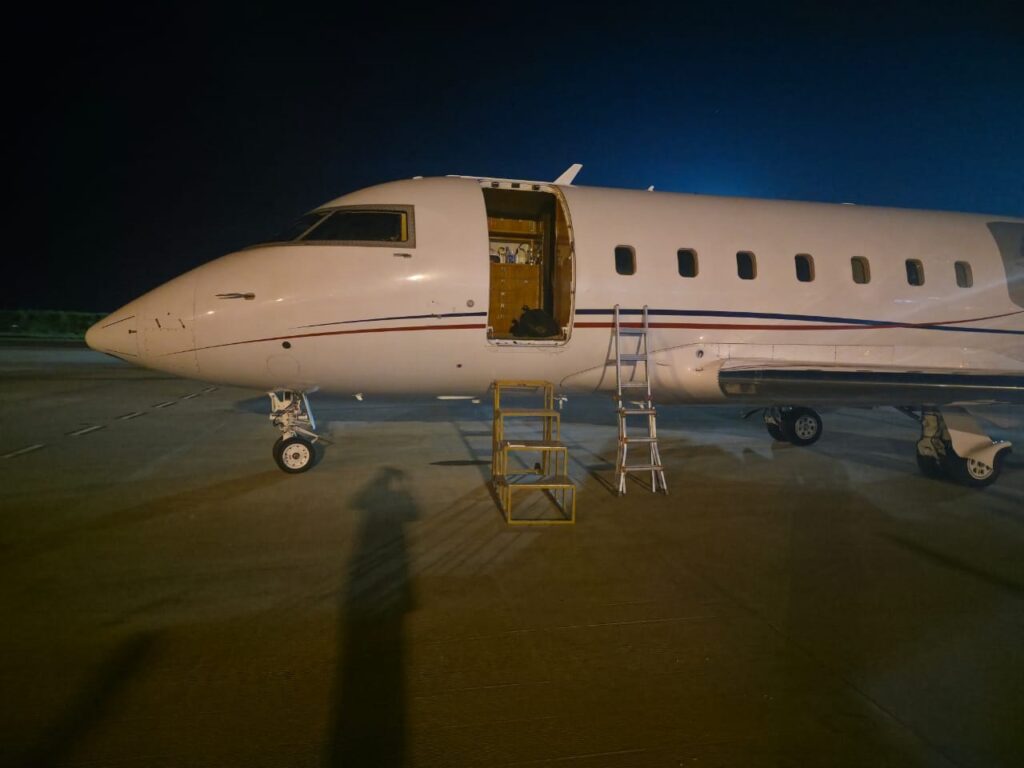
The Bureau said its investigation had commenced and that further updates would be provided as the process progressed.

FG Pushes Gulf of Guinea Policy to Curb Illegal Fishing

NIWA Orders Quarterly Boat Checks, Targets 80% Cut in Accidents

Ebola Alert: FAAN Strengthens Airport Vigilance, Urges Calm

Air Peace Expands Domestic Flight Schedule

Lufthansa Group to Bring Eurowings to Nigeria in 2027

Gateway International Airport Takes Off as Ogun Joins Nigeria’s Air Map
-
 Airlines4 months ago
Air Peace Expands Domestic Flight Schedule
-
 Airlines2 months ago
Lufthansa Group to Bring Eurowings to Nigeria in 2027
-
 Aviation1 year ago
Gateway International Airport Takes Off as Ogun Joins Nigeria’s Air Map
-

 Airlines1 year ago
₦100m Land Deal: Air Peace Backs Onyema’s Claim on Anambra Airport
-

 Aviation1 year ago
Nigeria, UAE Firm Sign Landmark Cargo Information Deal
-

 Airlines1 year ago
High Airfares, Hot Hotels: Nigeria’s Travel Paradox
-
 Airlines1 year ago
UK Partnership Opens Heathrow, Gatwick Gates for Air Peace – Onyema
-

 AIRPORTS1 year ago
MMA2 Named Nigeria’s Best Cargo Airport, Jibodu Honored