
Airspace
NAMA Extends AFTN to 26 Airports Ahead of AMHS Migration

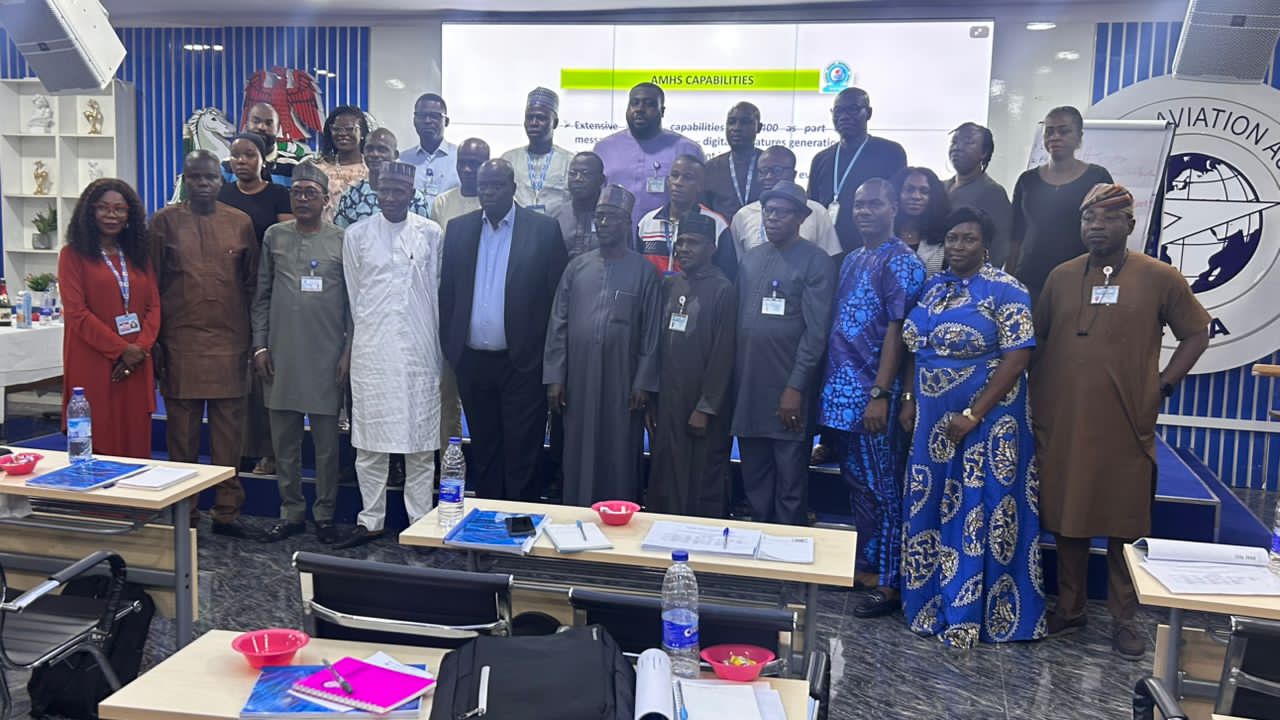
The Nigerian Airspace Management Agency (NAMA) has expanded the reach of its Advanced Satellite Aeronautical Fixed Telecommunications Network (AFTN) from 14 airports to 26 nationwide, a major stride in strengthening Nigeria’s aeronautical communication infrastructure.
The AFTN upgrade, which operates on X.25 protocols, is designed to serve as a reliable backup to the soon-to-be-commissioned Aeronautical Message Handling System (AMHS).
The AMHS, built on more advanced X.400 and X.500 protocols, is part of NAMA’s wider migration to the global Air Traffic Services Message Handling System (ATSMHS), which will integrate Nigeria more seamlessly into international aeronautical communication.
Industry experts have commended NAMA’s Managing Director and Chief Executive, Engr. Farouk Umar, for driving this initiative, describing it as a landmark achievement that reinforces Nigeria’s leadership in aviation safety and innovation.

Under his stewardship, the agency has consistently pursued modernization projects that align with global aviation standards.
With the extended AFTN, the aviation sector gains improved resilience and reliability in the transmission of aeronautical messages. The system ensures that crucial safety and operational information remains accessible at all times, even in cases where the primary system experiences downtime. This enhanced infrastructure provides pilots, controllers, and other aviation stakeholders with a robust communication platform, ultimately boosting flight safety and efficiency.

The milestone also comes as NAMA prepares to commission its Aeronautical Information Services (AIS) Automation Project, another transformative development aimed at modernizing Nigeria’s airspace management. Together, both projects reflect the agency’s readiness to adopt next-generation aviation technologies and reaffirm its compliance with International Civil Aviation Organization (ICAO) standards.
Speaking on the development, aviation stakeholders noted that Engr. Umar’s vision and commitment to technological advancement have positioned NAMA as a strong player in global air navigation services. His leadership, they said, has not only accelerated Nigeria’s transition to advanced communication systems but also strengthened the nation’s reputation for aviation safety, innovation, and operational excellence.
Airspace
NAMA Director Wins APWEN Public Service Award
NAMA’s Engr. Terese Ihenachor proudly displays the Outstanding Public Service Award conferred on her by APWEN Lagos for her leadership in engineering and public service.

The Director of Safety Electronics and Engineering Services at the Nigerian Airspace Management Agency (NAMA), Engr. Terese Ihenachor, has received the Outstanding Public Service Award from the Lagos Chapter of the Association of Professional Women Engineers of Nigeria (APWEN).
Ihenachor was honoured at the maiden APWEN Lagos Engineering Summit 2026 for her contributions to engineering excellence, the empowerment of women engineers and sustainable professional development.
The award recognises her leadership in the aviation sector, particularly her role in strengthening the maintenance, modernisation and reliability of critical Communications, Navigation and Surveillance/Air Traffic Management (CNS/ATM) infrastructure across Nigeria.
Ihenachor made history in December 2023 when she became NAMA’s first female substantive Director of Safety Electronics and Engineering Services.
Since assuming the position, she has provided strategic direction for the maintenance and upgrade of safety-critical systems supporting air navigation and flight operations across the country.
A statement signed by NAMA’s Director, Public Affairs and Consumer Protection, Dr. Abdullahi Musa, said the directorate had recorded significant progress under Ihenachor’s leadership in the upgrade and deployment of critical communication, navigation and surveillance facilities.
The agency said she had also strengthened maintenance regimes for safety-critical systems, improved technical planning and operational coordination, and prioritised the timely calibration of navigational aids to ensure their accuracy, integrity and compliance with applicable international standards.
One of the major demonstrations of her technical leadership was the recent deployment of a Mobile Control Tower at Murtala Muhammed International Airport, Lagos, following a fire incident that affected critical air-ground communication infrastructure at the old terminal.
The swift deployment helped ensure continuity of safe air navigation services at Nigeria’s busiest aviation hub.
Under Ihenachor’s technical supervision, the mobile facility was tested and adapted to Nigeria’s operational requirements through local innovations, including a smart flight-strip system and seamless connectivity with NAMA’s Centrex and Total Radar Coverage of Nigeria systems.
NAMA said arrangements had also commenced for the deployment of another mobile control tower to support Runway 18R.
Ihenachor joined the civil aviation sector in 1994 and rose through various technical and managerial positions, including General Manager, Workshop, Planning and Logistics, before her appointment as director.
Beyond her professional responsibilities, she has been involved in initiatives aimed at increasing female participation in engineering and other science, technology, engineering and mathematics fields.
She is a Fellow of the Nigerian Society of Engineers, Nigerian Institute of Electrical and Electronic Engineers and Nigerian Institute of Management.
She is also a former Secretary and Treasurer of APWEN and founded the Girl-Child Engineer Initiative to promote greater participation of girls and women in engineering.
According to APWEN, the award was part of efforts to celebrate women whose leadership is contributing to the advancement of engineering, innovation and efficiency in public service.
Airspace
NAMA Alerts Job Seekers Over Fake Appointment Letters
NAMA’s Managing Director and Chief Executive, Engr. Farouk -Ahmed Umar
The Nigerian Airspace Management Agency (NAMA) has raised the alarm over a recruitment scam involving fake appointment and employment letters issued to unsuspecting job seekers in the name of the agency.
NAMA said it is not currently recruiting, warning that individuals, groups or organisations claiming to facilitate employment or issue appointment letters on its behalf have no approval or authorisation from the agency.
The warning was contained in a statement signed by NAMA’s Director of Public Affairs and Consumer Protection, Dr Abdullahi Musa, who said the agency views the development with serious concern.
According to NAMA, the fraudulent activities are targeted at innocent job seekers and could expose victims to financial losses and the theft or misuse of sensitive personal information.
The agency consequently advised members of the public not to pay money or provide sensitive personal details to anyone claiming to have secured employment for them with NAMA.
It urged prospective applicants to independently verify any recruitment announcement, employment communication or appointment letter allegedly issued by the agency through its recognised official channels before responding.
NAMA also advised the public to disregard unofficial recruitment messages circulated through social media and other channels, particularly communications from intermediaries claiming to have access to employment opportunities within the agency.
The agency stressed that it does not authorise individuals or third parties to solicit money or any other consideration in exchange for employment.
It called on members of the public to report suspected cases of impersonation and fraudulent representation to the appropriate authorities.
NAMA also disclaimed responsibility for any financial loss or other consequences suffered by persons who transact with fraudsters or unauthorised individuals falsely claiming to represent the agency.

The agency reaffirmed its commitment to transparency and institutional integrity, while assuring the public of its continued efforts to protect its corporate identity and prevent fraudulent activities carried out in its name.
Airspace
NAMA Highlights Welfare Reforms, Moves to Clear Retirees’ Benefits
NAMA’s Managing Director and Chief Executive, Engr. Farouk -Ahmed Umar
The Nigerian Airspace Management Agency (NAMA) has reaffirmed its commitment to staff welfare and the settlement of outstanding retirees’ benefits, stating that significant progress has been made under the leadership of its Managing Director, Engr. Farouk Ahmed Umar.
The agency made the clarification in a statement issued by the Director of Public Affairs and Consumer Protection, Dr. Abdullahi Musa, in response to recent public comments concerning retirees’ entitlements and allegations against the management.
According to NAMA, the issue of unpaid retirees’ benefits predates the current administration and stems from longstanding institutional challenges linked to pension administration, policy implementation gaps and public-sector bureaucratic processes.
The agency, however, stressed that renewed efforts to address the matter began under the present management, with Engr. Farouk securing the necessary approvals and directing relevant departments to commence processes aimed at settling the outstanding obligations.
NAMA explained that the disbursement of such entitlements must comply with statutory requirements, including documentation, budgetary provisions, administrative verification and government approvals.
While acknowledging the concerns of retirees, the agency maintained that the delays should not be interpreted as neglect, noting that due process remains essential in the management of public funds.
Beyond retirees’ welfare, NAMA highlighted what it described as landmark staff-focused reforms implemented by the current administration. These include the successful implementation of the agency’s Staff Conditions of Service in full, a long-standing demand by workers that previous administrations were unable to achieve.
The agency also disclosed that a new salary structure had recently been approved and implemented, resulting in improved remuneration, enhanced welfare packages and increased staff morale across the organisation.
According to the statement, the administration has further invested in human capacity development through expanded local and international training opportunities, improved working conditions and sustained engagement with both serving and retired personnel.
NAMA said the reforms have contributed to greater institutional stability, enhanced operational efficiency and improved service delivery within Nigeria’s aviation sector.
The agency also rejected allegations suggesting the diversion of public resources for personal religious activities, describing such claims as false and unfounded.
It reiterated that NAMA remains committed to professionalism, inclusiveness and national unity, stressing that religion has no place in administrative decision-making within the agency.
The statement further noted that under Engr. Farouk’s stewardship, NAMA has continued to strengthen navigational infrastructure, improve operational safety systems, develop technical manpower and maintain compliance with international aviation standards.
According to the agency, these achievements have earned recognition from stakeholders across the aviation industry and underscore the management’s commitment to institutional transformation and staff welfare.

More Airlines, Same Airports, Bigger Crisis

Airlines, Labour Clash Over N5% TSC

LAAC Moves to Balance Aviation Revenue, Growth

Air Peace Expands Domestic Flight Schedule

Gateway International Airport Takes Off as Ogun Joins Nigeria’s Air Map

₦100m Land Deal: Air Peace Backs Onyema’s Claim on Anambra Airport
-
 Airlines3 months ago
Air Peace Expands Domestic Flight Schedule
-
 Aviation11 months ago
Gateway International Airport Takes Off as Ogun Joins Nigeria’s Air Map
-
 Airlines11 months ago
₦100m Land Deal: Air Peace Backs Onyema’s Claim on Anambra Airport
-

 Aviation12 months ago
Nigeria, UAE Firm Sign Landmark Cargo Information Deal
-

 Airlines11 months ago
High Airfares, Hot Hotels: Nigeria’s Travel Paradox
-
 Airlines12 months ago
UK Partnership Opens Heathrow, Gatwick Gates for Air Peace – Onyema
-

 AIRPORTS12 months ago
MMA2 Named Nigeria’s Best Cargo Airport, Jibodu Honored
-

 Airlines11 months ago
Aborted Take-off: Air Peace Assures Passengers of Safety on Abuja–Asaba Flight