
Aviation
NANTA @50 Honours LAAC
Pix from left Mrs Adelola Adewole, PRO, National Association of Nigeria Travel Agencies (NANTA); Mr Adeyinka Ladipo, Financial Secretary NANTA; Mr Anthony Awunor, Secretary, League of Airport and Aviation Correspondents, LAAC and Mrs Nosa Aituamen-Osula, Secretary, Gateway Committee, LAAC during a Special recognition award presented to League of Airport and aviation Correspondents, LAAC at the NANTA 50th Annual General Meeting held in Ibadan, Oyo state over the weekend

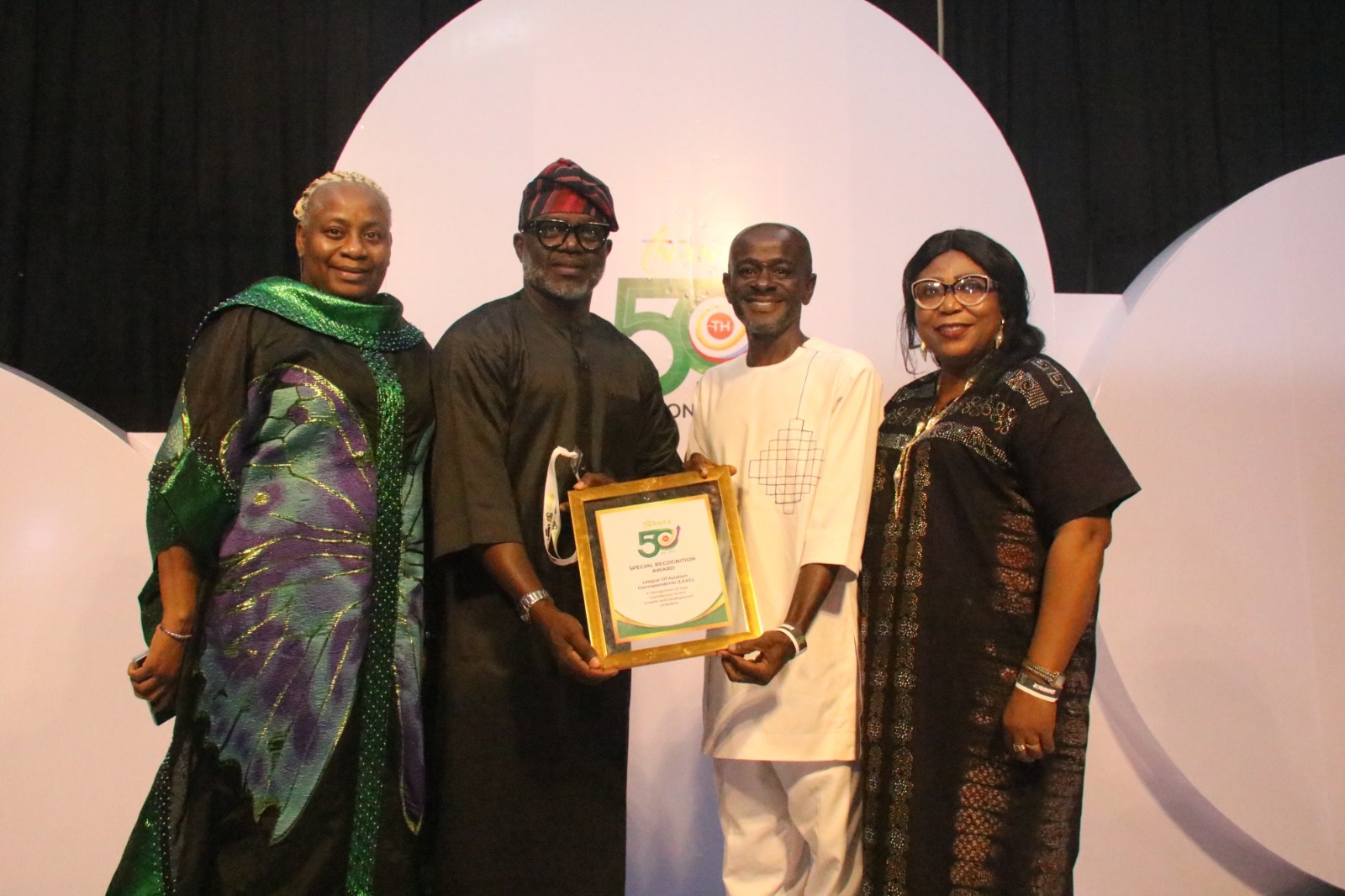
The League of Airport and Aviation Correspondents (LAAC) has taken centre stage at the golden jubilee celebration of the National Association of Nigerian Travel Agencies (NANTA), earning top honours for its pivotal role in shaping Nigeria’s aviation and travel landscape.
At NANTA’s landmark 50th Annual General Meeting (AGM), held from April 14 to 18, 2026, in Ibadan, LAAC was presented with a Special Recognition Award, an endorsement of its enduring influence in advancing aviation, tourism, and travel reporting in Nigeria.
The award, presented during a high-profile Dinner and Award Night at the Jogor Event Centre, drew resounding applause from industry leaders, regulators, and global travel stakeholders gathered to celebrate NANTA’s 50-year legacy.
Presenting the honour on behalf of NANTA, its Public Relations Officer, Adelola Adewole, described LAAC as a critical pillar in the industry’s growth architecture, underscoring the media’s role in driving transparency, accountability, and sector-wide engagement.
Receiving the award, LAAC General Secretary, Anthony Awunor, commended NANTA for its objectivity and consistency, reaffirming the association’s commitment to strengthening collaboration across the aviation ecosystem.
“This recognition reinforces the importance of credible media engagement in driving industry growth. We will continue to work with stakeholders to deepen development and alignment across the sector,” Awunor stated.
The golden jubilee AGM held under the theme “Embracing Our Diverse Cultural Heritage from the City of Firsts: Redefining Our Role as Global Travel Ambassadors” was more than a celebration. It served as a strategic platform to reposition Nigeria’s travel trade within the global ecosystem while unlocking economic opportunities in the Western region.
NANTA President, Yinka Folami, described the 50-year milestone as a legacy moment, emphasizing the association’s enduring role as the organized voice of Nigeria’s downstream travel sector.
“Fifty years is not just a number; it is a legacy,” Folami declared, highlighting NANTA’s impact in setting industry standards, ensuring compliance, and advocating for over 3,500 travel professionals nationwide.
He noted that the association’s leadership has focused on fairness, market protection, and industry strengthening, backed by transparency and accountability, while maintaining active engagement with government on taxation, regulatory frameworks, and cross-border travel policies.
Beyond the awards, the event featured technical sessions, tourism asset inspections, cultural showcases, and city tours reinforcing Ibadan’s status as a hub of heritage and economic potential.

For LAAC, the recognition signals more than an award, it cements its position as a driving force behind informed discourse and sustainable growth in Nigeria’s aviation and travel sectors.
Aviation
Keyamo: Nigeria’s 91.45% ICAO Score Sets New Aviation Baseline
Minister of Aviation and Aerospace Development, Festus Keyamo, SAN, addressing delegates at the opening of the 35th ACI Africa Annual General Assembly, Regional Conference and Exhibition in Abuja on Tuesday.

Nigeria’s Minister of Aviation and Aerospace Development, Festus Keyamo, has described the country’s record 91.45 per cent Effective Implementation score in the 2026 ICAO Coordinated Validation Mission as a new baseline for the nation’s aviation sector, saying the government will continue to raise safety and operational standards.
Keyamo spoke on Tuesday in Abuja at the opening of the 35th Annual General Assembly of the Airports Council International (ACI) Africa, the 76th Board and Committee Meetings, and the Regional Conference and Exhibition.
According to the minister, the 91.45 per cent score, Nigeria’s highest-ever result and above the global average, demonstrated that sustained reforms, professional commitment and institutional collaboration could deliver measurable improvements in the aviation sector.
He, however, stressed that the achievement should not be regarded as the destination for the country’s aviation industry.
“91.45 percent is not our destination. It is our new baseline. We must continue to raise the bar,” Keyamo said.
The minister also highlighted the Federal Government’s ongoing efforts to modernise Nigeria’s airport infrastructure, particularly the rehabilitation and expansion of Terminal 1 of the Murtala Muhammed International Airport, Lagos.
He said the project was aimed at transforming the historic gateway into a more modern, efficient and passenger-centred international airport.
Keyamo said the government viewed airports beyond their traditional role as facilities for aircraft operations, describing them as economic ecosystems capable of creating jobs, supporting tourism and logistics, attracting investment, facilitating trade and connecting businesses to markets.
He said Nigeria was encouraging greater private-sector participation in airport infrastructure and services while maintaining the safety, security, service and public-interest standards required in the industry.
The minister added that the government was supporting the development of Maintenance, Repair and Overhaul facilities, aircraft leasing, cargo infrastructure and other components of the aviation value chain.
“Our ambition is straightforward: Nigeria should not merely consume aviation services. We must increasingly produce aviation value. And we believe Africa should do the same,” he said.
Keyamo also called for stronger intra-African air connectivity, stressing that it should not be easier to travel between an African city and a destination outside the continent than between two African cities.
He said stronger connectivity, commercially viable airports, appropriate regulatory frameworks and closer cooperation among governments, airlines and airport operators were necessary to deepen African aviation.
The minister identified the Single African Air Transport Market as an important framework for advancing the continent’s connectivity ambitions, while noting that aviation had a major role to play in making the African Continental Free Trade Area’s economic integration a reality.
On the future of airports, Keyamo said next-generation facilities must go beyond larger terminal buildings to become safer, more efficient, financially sustainable, technologically enabled, environmentally responsible and resilient to disruptions.
He said African airports must embrace digital transformation, smarter infrastructure, data-driven decision-making and innovative commercial models, while ensuring that technology remained focused on improving the passenger experience.
“Technology is only meaningful when it makes a person’s journey safer, easier, faster and more dignified,” he said.
Keyamo further urged African airport leaders to work collectively to address common challenges, attract investment, develop professional capacity and establish policies capable of strengthening the continent’s aviation industry.
The ACI Africa gathering, which brings together airport leaders and aviation stakeholders from across Africa and beyond, is themed, “Next-Gen Airports: Driving Performance and Resilience.”
Keyamo said ACI Africa, which represents 64 members in 51 countries and about 250 airports, had an important role to play in promoting collaboration, knowledge-sharing, advocacy and professional development across the continent.
He also acknowledged the contribution of Nigeria’s aviation professionals to the continent, particularly the Managing Director/Chief Executive of the Federal Airports Authority of Nigeria, Mrs. Olubunmi Kuku, who serves as Vice-President of ACI Africa.
The minister urged delegates to ensure that the outcomes of the conference translated into concrete policies, partnerships, investments and projects that would strengthen African airports.

He subsequently declared open the 35th ACI Africa Annual General Assembly, the 76th Board and Committee Meetings, and the Regional Conference and Exhibition.

Enugu Air is set to reposition Enugu as a regional aviation gateway with the launch of direct flights from Akanu Ibiam International Airport to Douala, Cameroon, opening a new connection between South-Eastern Nigeria and Central Africa.
The new Enugu-Douala service, scheduled to commence on September 23, will operate twice weekly on Mondays and Wednesdays with an Embraer E170 aircraft.
Beyond connecting Nigeria and Cameroon, the airline said the new route is structured to make Enugu a convenient connecting point for passengers travelling from Lagos and Abuja to the Central African market.
Chief Operating Officer of Enugu Air, Ugonna Agubuokwu, said the new service would expand the role of Enugu in regional air travel by bringing businesses, families and commercial opportunities in Nigeria and Cameroon closer together.
“This is more than the introduction of a new route; it is about creating stronger connections between Nigeria and Cameroon and making regional travel more accessible, convenient and seamless for our passengers,” Agubuokwu said.
The airline said the new service would particularly provide traders and business travellers from the South-East with a direct alternative to travelling through Lagos before connecting to Cameroon or undertaking lengthy overland journeys.
Under the schedule, flights will depart Enugu at 12:45 p.m. and arrive at Douala International Airport at 1:45 p.m. The return flight will leave Douala at 2:30 p.m. and arrive in Enugu at 3:30 p.m.
Agubuokwu said the timing was deliberately designed to accommodate passengers connecting from Lagos and Abuja, potentially allowing travellers from the two major Nigerian cities to use Enugu as their gateway to Douala.
“The timing has been optimised so that passengers can conveniently connect from Lagos and Abuja. For business, for opportunity, and for the connections that matter, Africa is closer than you think,” he said.
The launch marks a shift in Enugu Air’s operations from an exclusively domestic network to regional services, with the airline seeking to extend the reach of its Enugu-based operations beyond Nigeria.
Its existing domestic network covers Lagos, Abuja, Port Harcourt, Kano, Asaba, Benin City, Owerri and Warri.
With the introduction of the Douala route, Enugu is expected to take on a new role within the airline’s network, serving not only passengers originating from the South-East but also travellers from other parts of Nigeria seeking access to Central and West African destinations.
The development is also expected to strengthen direct air connectivity between the South-East and Cameroon by providing an alternative to itineraries that require passengers to connect through Lagos or use road transportation for part of the journey.
The regional expansion forms part of the economic development agenda of Enugu State Governor, Peter Mbah, under which the state-backed airline has expanded its domestic operations and is now extending its network beyond Nigeria.
The Enugu-Douala route therefore represents the airline’s first step into regional operations and gives the South-East a direct international air connection to Cameroon from Enugu.
The new service is expected to support movement between the two markets for business, trade, family visits and other forms of regional travel while strengthening Enugu’s position within the wider African aviation network.
Airspace
NAMA: Safety Forced Removal of Lagos CAT III ILS
Director of Safety, Electronic and Engineering Services (DSEES), NAMA. Engineer Teresa Ihenachor,

The Nigerian Airspace Management Agency (NAMA) has said the Category III Instrument Landing System (CAT III ILS) installed at the Murtala Muhammed International Airport (MMIA), Lagos, was removed because of persistent failures that raised safety concerns.
The agency’s Director of Safety, Electronic and Engineering Services (DSEES), Teresa Ihenachor, who disclosed this in Lagos, said NAMA did not abandon the equipment as alleged, stressing that its removal was a safety-driven decision after repeated attempts to restore its reliability failed.
Ihenachor spoke on the sidelines of the 30th Annual Conference of the League of Airport and Aviation Correspondents (LAAC) in Lagos.
She said the Lagos CAT III ILS had a history of unserviceability before she assumed office, adding that she personally supervised more than seven repairs of the system within a short period, but the equipment continued to develop faults.
“We did not abandon anything. It was removed for safety,” Ihenachor said.
According to her, the equipment was highly sensitive to its operating environment and continued to produce unreliable performance even after it had been downgraded from CAT III to CAT II.
She explained that the problem was not simply the ILS itself but the absence of the supporting infrastructure and environmental conditions required for CAT III operations in Nigeria.
Ihenachor specifically pointed to the condition of airfield lighting at the Lagos airport, which she said remained at CAT I, making the deployment of a CAT III ILS incompatible with the existing infrastructure.
“Our airfield lighting is still on CAT I. Most of our equipment are downgraded to CAT II. So, having CAT III with the airfield lighting at CAT I is very difficult,” she said.
She added that even after the Lagos system was downgraded to CAT II, it failed to operate optimally, forcing the agency to consider the safety implications of keeping an unreliable navigational aid at one of the country’s busiest airports.
Ihenachor said the frequent failures became a concern because an ILS is expected to provide reliable guidance to aircraft, particularly during poor visibility and other conditions requiring precision approach support.
She said NAMA consequently obtained permission from the supervising ministry to remove the problematic equipment and install a new CAT II ILS that was available for another station.
“So, I wrote, I took permission from them because of the safety nature. So, I installed a brand new ILS, this NORMARC CAT II which is functioning up to now,” she said.
The DSEES said the replacement CAT II system has continued to function reliably, with the agency addressing the power-related challenges through the use of a solar power system.
She maintained that the CAT III equipment had not been rendered useless, explaining that the systems could still be deployed at other airports where their operational requirements could be met.
According to her, the CAT III system at Abuja was also downgraded to CAT II because of the same limitations, while plans were being considered to redeploy some of the equipment to other airports.
“The one in Abuja, it’s not functioning, but it’s downgraded. And you imagine,” she said, adding that equipment could be deployed to locations such as Calabar where there is a need for ILS.
Ihenachor stressed that CAT III operations require more than the installation of the ILS equipment, noting that supporting facilities such as appropriate airfield lighting, stable power supply and other associated technical requirements must be available.
She said NAMA had addressed the power challenge but noted that airfield lighting was under the responsibility of the Federal Airports Authority of Nigeria (FAAN).
“The bottom line is CAT III cannot function in Nigeria due to non-compliance with the environmental requirements. Not only environmental, there’s an associated requirement that it needs. Like I told you, airfield lighting,” she said.
The NAMA director advised that the supporting infrastructure should be upgraded before the deployment of CAT III ILS equipment, arguing that acquiring sophisticated equipment without first adapting the airport environment to its requirements could undermine its effectiveness.

She said the experience with the Lagos installation demonstrated the importance of matching navigational equipment with the infrastructure and environmental conditions of the airport where it would be deployed.
Ihenachor also defended NAMA’s response to the fire incident that affected the airport’s control tower facilities earlier in the year, saying the agency quickly deployed a mobile control tower and adapted it to meet its operational requirements.
She said NAMA installed additional facilities in the mobile tower because the equipment, as supplied, did not contain everything required for its operations.
According to her, the agency later identified a power shortfall caused by the additional equipment it had installed and subsequently upgraded the power capacity.
She said the agency also subjected the facility to a safety assessment before air traffic controllers were allowed to return to the tower.
Ihenachor said the agency had additionally deployed mobile radio transceiver equipment as a safety backup, allowing air traffic controllers to communicate with and control aircraft when necessary.
She stressed that safety considerations remained central to NAMA’s decisions on navigational and air traffic management equipment.

The clarification comes amid public questions over the status of the CAT III ILS systems acquired for Lagos and Abuja. NAMA has separately disputed reports that the systems cost ₦7.58 billion, stating that the approved contract for the supply and installation of CAT III-capable ILS and Distance Measuring Equipment for the two airports was ₦1.188 billion.

Keyamo: Nigeria’s 91.45% ICAO Score Sets New Aviation Baseline

Enugu Air Opens Enugu-Douala Regional Link

NAMA: Safety Forced Removal of Lagos CAT III ILS

Air Peace Expands Domestic Flight Schedule

Lufthansa Group to Bring Eurowings to Nigeria in 2027

Gateway International Airport Takes Off as Ogun Joins Nigeria’s Air Map
-
 Airlines3 months ago
Air Peace Expands Domestic Flight Schedule
-
 Airlines4 weeks ago
Lufthansa Group to Bring Eurowings to Nigeria in 2027
-
 Aviation12 months ago
Gateway International Airport Takes Off as Ogun Joins Nigeria’s Air Map
-

 Airlines12 months ago
₦100m Land Deal: Air Peace Backs Onyema’s Claim on Anambra Airport
-

 Aviation12 months ago
Nigeria, UAE Firm Sign Landmark Cargo Information Deal
-

 Airlines12 months ago
High Airfares, Hot Hotels: Nigeria’s Travel Paradox
-
 Airlines12 months ago
UK Partnership Opens Heathrow, Gatwick Gates for Air Peace – Onyema
-

 AIRPORTS1 year ago
MMA2 Named Nigeria’s Best Cargo Airport, Jibodu Honored